


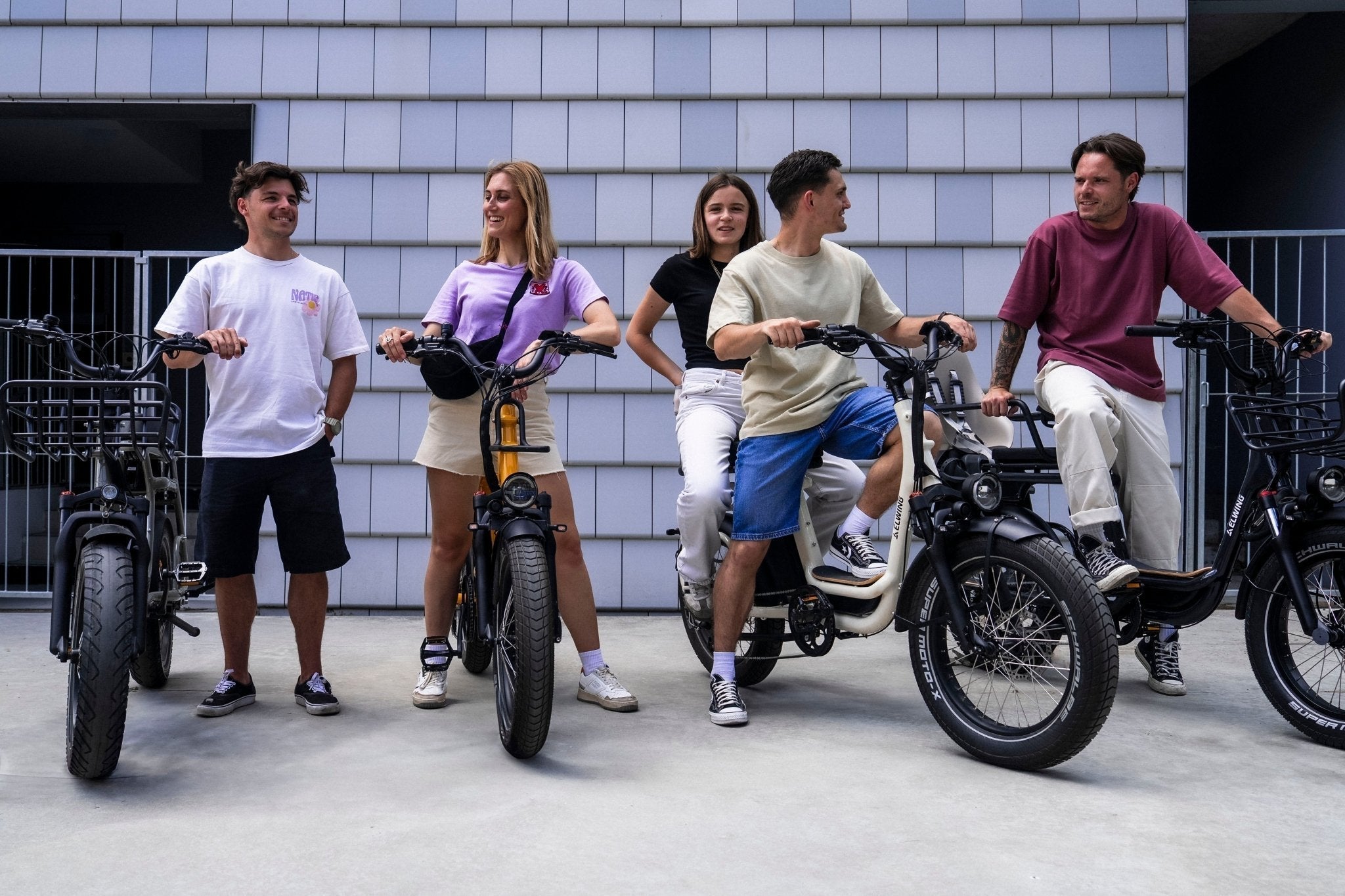
In recent months, a strange vocabulary has flooded the media: “fat bike,” “skinny bike,” “fake bike,” “disguised motorcycle”… At this rate, one might almost believe that a wide tire has become suspicious. Yet, not all electric bikes with big tires are the same. And above all: they don’t all operate the same way.
At Ritmic, we design approved electric cargo bikes for everyday use: transporting a loved one, groceries, a child, or simply riding more comfortably in the city.
So let’s keep it simple. And put a little order back into the vocabulary.
Welcome to the semantic jungle of electric bikes.
You may have read the Frandroid article reporting the situation in the Netherlands: Amsterdam and Enschede ban certain fatbikes equipped with very wide tires, and some manufacturers are already responding with “skinny bikes,” fatbikes with thinner tires, to bypass the restrictions.
The issue goes far beyond the Netherlands.
In recent months, terms like “fatbike,” “fake bike,” “unlocked bike,” or “disguised motorcycle” have been multiplying in the media.
The problem? This drift fuels a dangerous confusion: after hearing so much about "illegal fatbikes" and "bikes that aren’t really bikes," we end up lumping all wide-tire bikes together. And that seems unfortunate to us. Because a cargo bike is not a fatbike. A wide tire is not necessarily an illegal tire. And a throttle is not always a clandestine accelerator.
A quick catch-up lesson, no sugarcoating.
Cargo bike, fatbike, longtail, skinny bike: the glossary to keep track.
The electric bike market has invented more categories than the SNCF has fare options. Let's recap.
The fatbike: Originally, a fatbike is a bike designed to ride on soft terrains like sand or snow, with very wide tires. So the problem does not come from the concept itself. The problem comes from some non-approved models that operate more like mopeds than bikes: constant assistance without pedaling, unlocking, excessive speed on bike paths, lack of insurance or registration.
The "skinny bike": The latest trend observed in the Netherlands: adopting some fatbike features but with thinner tires to comply with certain local regulatory limits. The motor, however, sometimes remains the same.
The cargo bike: a bike with a reinforced frame to carry heavy loads: groceries, children, surfboard, bulky items, or simply a passenger. It is a daily mobility tool, designed to replace the second car. Nothing to do with an unlocked leisure vehicle.
The longtail: is a family of cargo bikes with an extended frame at the rear to accommodate an XXL rack, two children, or a real load. The Jumbo belongs to this category.
At Ritmic, we chose wide tires. But not for the reasons you think.
Yes, our bikes have wide tires: between 8.5 and 9.5 cm depending on the model. It’s not just about looks. It’s a thoughtful technical choice, motivated by three very concrete things.
Stability, first. A cargo bike carries heavy loads, sometimes up to 180 kg payload on our models. A wider tire offers a larger contact surface with the ground, thus better road holding, especially with a child on the back.
Comfort, next. French bike lanes are not always smooth. Cobblestones, roots, poorly lowered sidewalks, slippery manhole covers: a wide tire absorbs shocks better and reduces the chances of tram rails throwing you off (useful reminder: always cross rails at an angle, never parallel).
Control, finally. The more the rubber grips, the more you feel in control of your trajectory. To carry a child or weave through traffic, it makes all the difference.
So yes, our tires are wide. But well below the "true" fatbikes (10 cm and more), and above all, they are mounted on a bike whose electric assistance is strictly limited to 25 km/h, as required by European regulations on electric-assist bikes (EAB).

The famous trigger: no, it is not a throttle
This is probably the point that causes the most confusion today. All Ritmic bikes have a start-assist trigger. Not to be confused with the "throttle" on unlocked fatbikes that turns the bike into a scooter.
Specifically, what is it for?
It gives you a very low-speed boost to start, especially when you are loaded (a child on the seat, a full basket, shopping bags, a hill starting at a red light). This initial push is what makes the difference between "I can start moving calmly" and "I drop the bike and its passenger."
And it is limited to 6 km/h. About the speed of a fast pedestrian. Beyond that, the throttle cuts off and your pedal power takes over, just like on any e-bike. To move forward, you have to pedal. The throttle is not an option to ride without effort; it’s a temporary aid, perfectly regulated by French and European law.
It complies with the NF EN 15194 standard, which defines legal electric-assist bikes in Europe. And it’s exactly the same frame respected by other serious brands on the market like Jean Fourche or Gaya, who row in the same direction as us to distinguish the family cargo bike from the beach fatbike.
The Ritmic range, explained to your neighbor
Now that we’ve laid the groundwork, here’s what our collection looks like, without jargon.
The Solo: the cargo bike that doesn’t pretend to be a cargo bike
The Solo is the bike for someone who rides alone most of the time but wants a sturdy frame, reassuring tires, and a rack that can carry much more than just a backpack. Its saddle is classic, like a "normal" bike. If you want to bring a passenger (adult or teen), we install a cushion on the rack: it stays compact, agile, perfect for narrow streets and tight parking spots. And if your passenger is a child, install a child seat (url) in one click thanks to the MIK HD interface. You get it, it’s much more than a classic single-rider bike.

The Duo: two or three seats
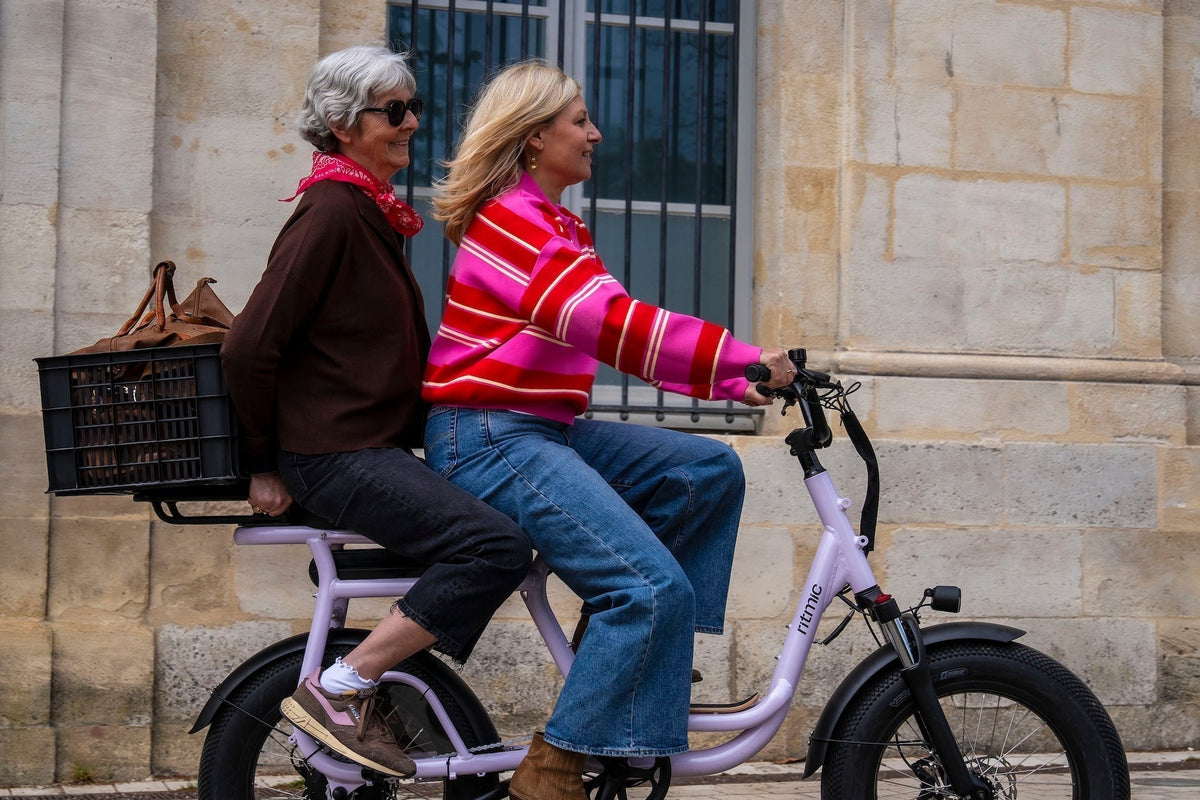
The Duo is our "two is better" bike. Its special feature? A prolonged saddle that seats two people on the bike itself (one adult driving, one adult or teen behind). Unlike the Solo, the passenger sits at the same level as the rider, ensuring unmatched comfort. And if you want to carry three, it accepts a child seat at the front or rear. Ideal for car-free couples, spontaneous outings, and school-work trips for two or three.

The Ritmic Jumbo: the XXL longtail for real family life
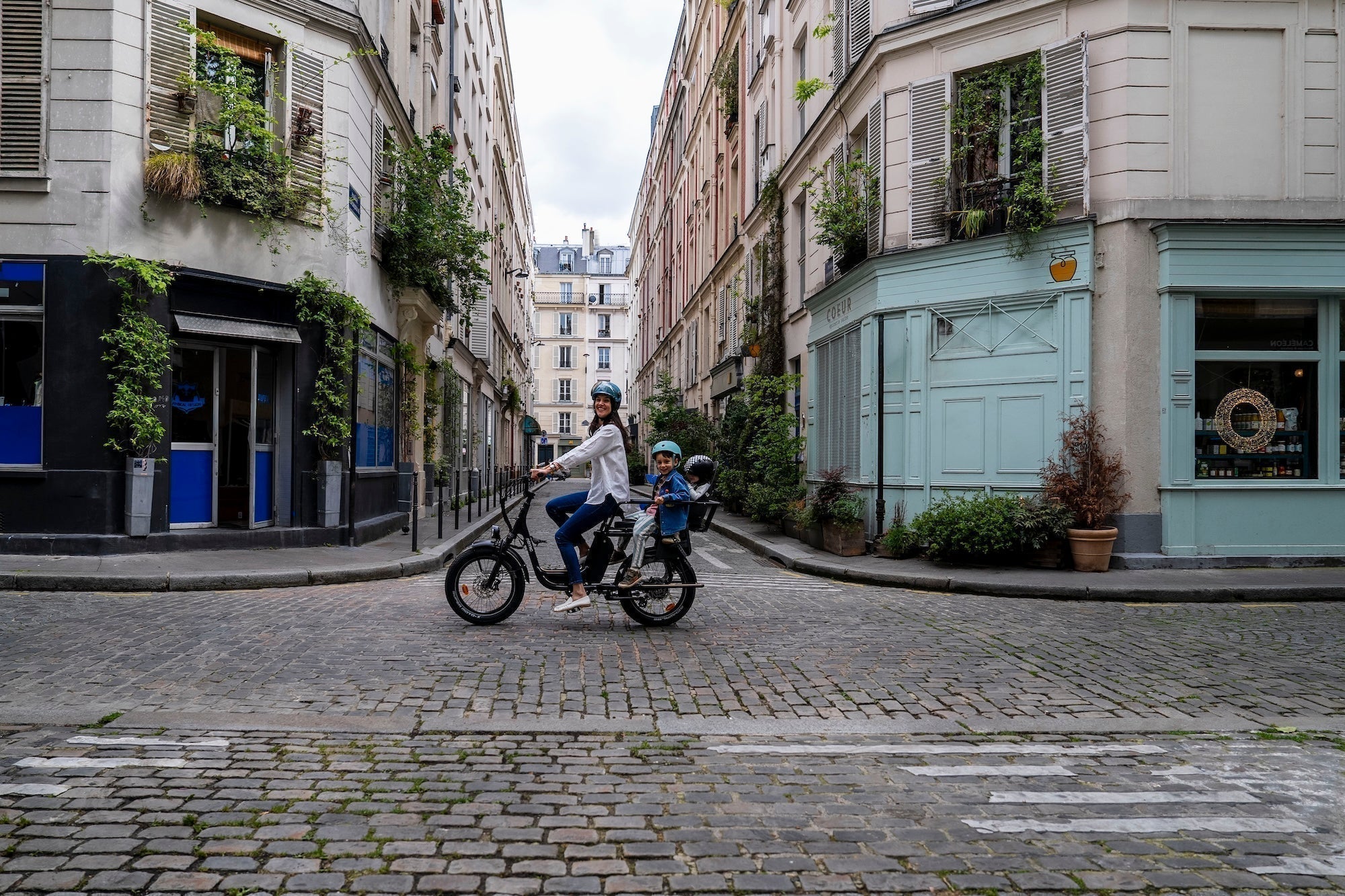
The Jumbo is our longtail cargo. Meaning: a bike with a frame extended at the rear to offer a large reinforced luggage rack. It’s the bike for families transporting two children to school, groceries for the week, or what a car trunk can carry. Need to take your two kids with all their gear for Wednesday activities? The Jumbo is made for that.

And what about the Yuvy?
Our first model, emblematic of the brand! Launched in 2020 when the brand was called Elwing, the Yuvy is a very compact, simple, and efficient two-seater. Since Elwing became Ritmic, we have been perfecting the Yuvy with a new version almost every year!

Summary table
| Model | Type | Number of seats | Tires | Start trigger | Certification |
|---|---|---|---|---|---|
| The Solo | Compact cargo | 1 adult + 1 passenger on luggage rack cushion | 8.5 cm | Yes - limited to 6 km/h | NF EN 15194 - Max load 180 kg |
| The Duo | Two-seat cargo (or three seats) | 2 adults (extended saddle) or 1 adult + 1 child (child seat) | 8.5 cm | Yes - limited to 6 km/h | NF EN 15194 - Max load 180 kg |
| The Jumbo | Longtail cargo | 1 adult + 2 children (seats) or bulky cargo | 8.5 cm | Yes - limited to 6 km/h | NF EN 15194 - Max load 180 kg |
| The Yuvy 3 | Two-seat cargo (or three seats) | 2 adults (extended saddle) or 1 adult + 1 child (child seat) | 9.5 cm | Not compatible | NF EN 15194 - Max load 180 kg |
Why this clarification?
Because confusion benefits some and harms everyone.
It benefits unscrupulous brands that sell illegal machines under the “bike” label. It harms serious brands: Ritmic, Gaya, Jean Fourche, UTO, Moustache, and many others who invest in compliance, safety, and wide tires because they’re useful, not to imitate fatbikes. And it especially harms users, who end up believing that no cargo bike is legal, while almost all of them strictly comply with European regulations.
An illegal fatbike unlocked to exceed 25 km/h without pedaling, is not a bike: it’s a moped. It must be registered, insured, and its rider must wear an approved helmet. Riding it on a bike path is a crime, not a leisure activity.
A Ritmic cargo electric bike is, well, a bike. With wide tires, sure. With a start trigger, sure. But limited to 25 km/h, equipped with assistance that only works if you pedal, and compliant with current European standards. It’s a daily mobility tool. It’s what France expects to decarbonize its cities.
🚨 A European-certified electric bike must comply with several rules:
- assistance limited to 25 km/h
- 250W nominal motor
- assistance only when pedaling
- compliance with EN15194 standard
Ritmic bikes comply with this regulation.
Throttle for Yuvy 2
Why this choice? European regulations are strict: to remain in the e-bike category, a bike must not exceed 25 km/h and assistance must only activate when pedaling. Offering accessories that allow exceeding these limits exposes us to legal reclassification. What this means for you:
- Sport Display: this product is no longer available for sale or as a warranty replacement.
- Throttle: this product is no longer available for sale or as a warranty replacement.
In conclusion: a bit of education, a lot of common sense
If you meet a neighbor who is unsure whether to choose an "electric bike" or a "fatbike," help them ask the right questions: Can I ride at a maximum of 25 km/h? Do I have to pedal to move forward? Is the bike compliant with the NF EN 15194 standard? If the answer to all three is yes, it’s an e-bike. Otherwise, it’s something else, and it might require a license plate.
At Ritmic (formerly Elwing), our electric bikes are certified. This has been our guiding philosophy since the very first pedal stroke: designing cargo bikes that simplify urban life, carry children, groceries, or surfboards, while remaining compliant with regulations. Bikes made to ride where they should: on bike lanes, within the rules, with assistance limited to 25 km/h.

Share: