



Transporting an infant in a cargo bike depends on the bicycle and the device used. Some two-wheelers specifically designed to accommodate a baby carrier with a suitable adapter allow transport from around 3 months of age, according to the manufacturer's recommendations. To use a conventional child seat, you must follow the age, weight, and conditions of use specified by its manufacturer. Many seats are intended for use from around 9 months, when the child is generally able to hold their head properly and remain seated steadily. For safe riding, three factors are particularly important: age-appropriate support, a bicycle equipped with effective brakes and passenger protection, and good everyday safety habits. The format also matters: longtails and compact cargo bikes are particularly easy to maneuver in dense urban areas, while two-wheelers allow you to keep the children in front of you.
From what age can a child be transported in a cargo bike?
Some cargo bikes, particularly two-wheelers specifically designed to accommodate a baby carrier or car seat with a dedicated adapter, may allow an infant to be transported from around 3 months of age. This option depends absolutely on the recommendations of the bicycle and transport-device manufacturers. Once the child can sit independently and steadily (generally at around 9 months), they can switch to a conventional child seat suited to their age and build.
There is no general legal threshold set at 3 months for transporting an infant by bicycle. When this option is offered, the minimum age and conditions of use are those specified by the bicycle and transport-device manufacturers. You must therefore always follow the age, weight, installation conditions, and compatibility requirements specified by the carrier and bicycle manufacturers.
When switching to a conventional child seat, the child's development is more important than their exact age: they must be able to sit upright independently and steadily. This stage generally occurs at around 9 months. Since every child develops at their own pace, 9 months is therefore a guideline, not an automatic threshold.
From a regulatory perspective, Article R431-11 of the French Highway Code provides that any child under 5 transported as a passenger must be placed in a seat designed for this purpose and equipped with a restraint system. The rider must also ensure that the child's feet cannot become caught between the fixed and moving parts of the bicycle. More generally, a passenger seat on a two-wheeled bicycle must be fitted with either a securing strap or at least one handle and two footrests.
| Child's age | Required support | Recommended equipment | Model examples |
|---|---|---|---|
| 3 to 9 months | Infant not yet able to sit independently | Device specifically intended and approved by the bicycle manufacturer for transporting an infant / Strictly comply with the device’s age, weight, and installation conditions | There is no standard bicycle seat for this age: an adapter holds a compatible shell, such as a Maxi-Cosi |
| From around 9 months | Can hold their head properly and remain seated stably | Approved child seat (EN 14344 standard) compatible with the bicycle, with restraint system and footrests | Urban Iki Ta-ke MIK HD, Thule Yepp 2 Maxi MIK HD, Bobike One Maxi |
| 5 years and older | Can sit independently | Suitable passenger seat; follow the configuration specified by the manufacturer and the equipment required by the Highway Code: safety strap or at least one handle and two footrests | Open junior seat such as Bobike One Junior, Jumbo Junior Passenger Kit (2 MIK cushions, footrests, safety bar), Qibbel - Junior 6+ MIK HD, Urban Iki - Junior MIK seat |
| 7 to 10-12 years | Older child | Seat suited to the passenger’s size and weight; safety strap or at least one handle and two footrests, in accordance with the Highway Code | Jumbo Child Passenger Kit, two-seater saddle on the Duo or the Yuvy 3 with handles and footrests |
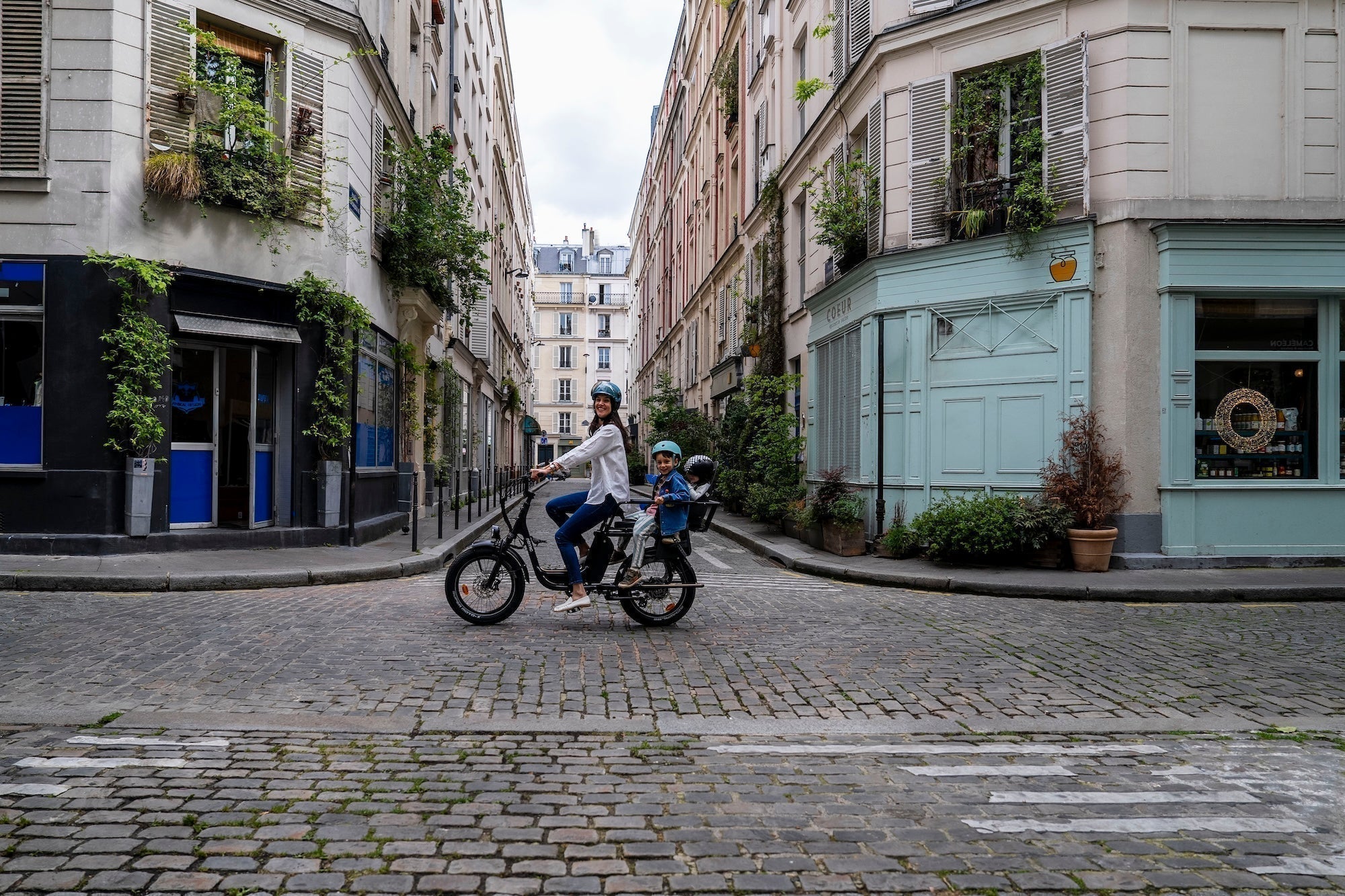
The right equipment must therefore evolve with the child. At Ritmic, the Jumbo, family longtail, is the most adaptable configuration: its rear rack can accommodate up to two older children, two baby seats, or one child and one baby, within the limits specified for the accessories installed. It can notably accommodate the Urban Iki Ta-ke MIK HD rear seat, the Junior Passenger Kit with two MIK cushions, the Child Passenger Kit, footrests, and a side-opening safety bar.
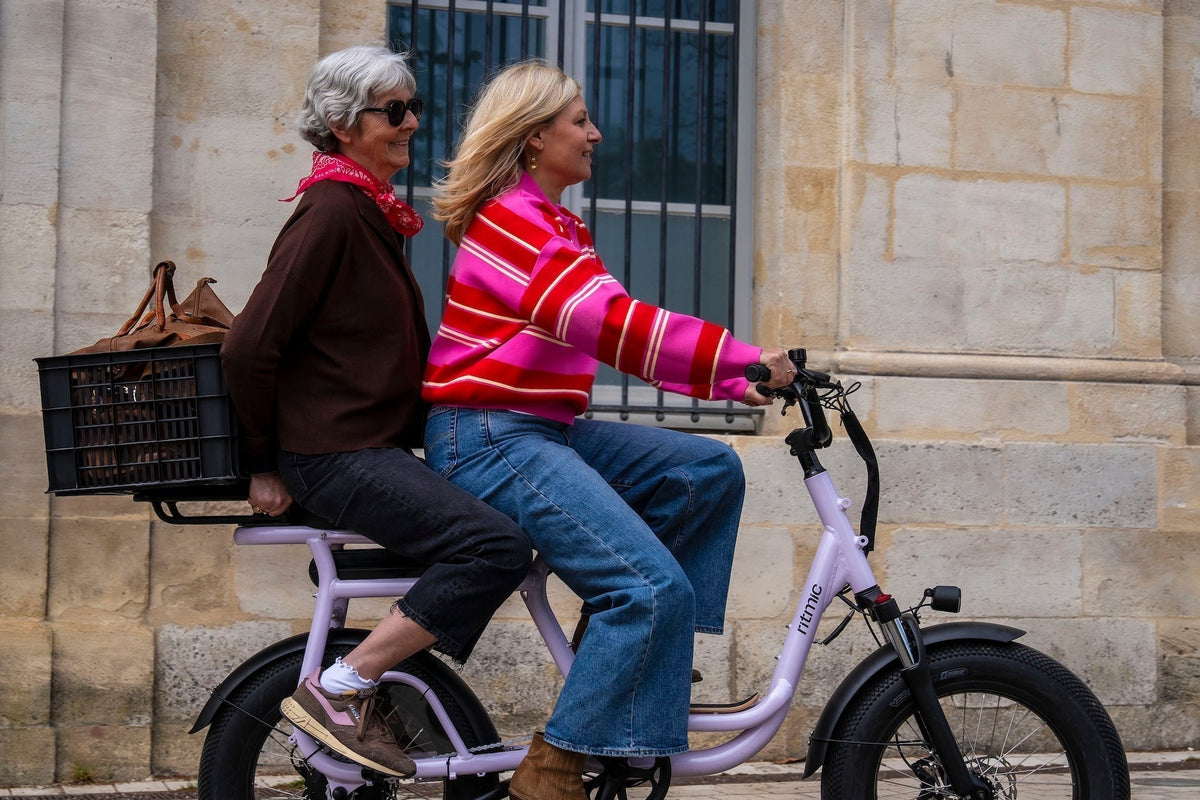
On the compact two-seater Yuvy 3 and Duo, the saddle can accommodate an adult or junior passenger, and a compatible child seat can be installed at the rear. Some configurations can therefore transport the rider and two passengers, within the capacity and compatibility limits specified by Ritmic.
Longtail, front-loader, compact: which configuration is safest in the city?
No cargo bike format is universally safer than another. The right choice depends on the children's ages, the journeys made, the space available for riding and parking, and how easily the rider can control the bike.
| Format | Safety advantage |
|---|---|
| Front-loader (front box) | Children in front of the rider, under direct supervision; load positioned low |
| Longtail (extended rear) | Riding feel close to a conventional bicycle, good maneuverability and narrow width |
| Compact two-seater | Short wheelbase and handling similar to an urban bike |
The front-loader has the advantage of placing children in a box in front of the rider. This is reassuring for keeping an eye on them and useful when regularly transporting young children. However, its larger footprint requires more anticipation in narrow passages and when parking.
In dense urban areas, where you have to navigate narrow cycle lanes, intersections and limited parking options, a narrow, maneuverable cargo bike can be easier to handle every day. The longtail retains a riding feel close to that of a conventional bicycle while offering substantial carrying capacity.
This is precisely Ritmic's approach: the Jumbo uses a longtail design intended for family transport, while the Yuvy 3 and the Duo favor a compact two-seat design. All four Ritmic models also feature a 6061 aluminum low-step frame, making it easier for the rider to get on and off: a particularly useful detail when managing one or two children at a stop.
What are the 6 safety criteria that really matter on an electric cargo bike?
Beyond the bike's format, braking, starting assistance, foot protection, passenger support, visibility and stability when stopped are the six key criteria to check before transporting children.
| Criterion | Why it matters | What Ritmic offers |
|---|---|---|
| Braking | Control stopping despite the weight of the bike and passengers | Tektro 4-piston hydraulic brakes, 180 mm rotors on the Jumbo, Yuvy 3, Duo and Solo |
| Starting assistance | Make it easier to set off with a load, especially uphill | Start-assist trigger up to 6 km/h fitted as standard across the entire range |
| Foot protection | Prevent feet from coming into contact with the wheel | Skirt guards fitted as standard across the entire range |
| Child restraint | Keep the passenger properly secured during the ride | Suitable child seats, harnesses/seat belts depending on the seat, footrests and protective barrier available on the Jumbo |
| Visibility and signaling | Be seen, be heard and make your intentions clearer | Lighting and brake light across the entire range; turn signals and electric horn on the Solo, Duo and Jumbo |
| Stability when stopped | Make it easier for children to get on and off | Aluminum center stand on the Yuvy 3, Duo and Jumbo |

1. Braking sized for riding with a load
Braking is probably the first component to examine on a bike intended to transport children. Once the bike, its rider, one or two passengers, and possibly groceries or schoolbags are added together, the moving mass increases significantly. Braking distances and anticipation must therefore be adjusted.
The Ritmic Jumbo, Yuvy 3, Duo and Solo all feature four-piston Tektro hydraulic brakes with 180 mm discs. The benefit of such a system is progressive, powerful braking, particularly when the bike is loaded or grip deteriorates.
More generally, the DGCCRF recommends checking a bicycle's braking, lighting and signaling equipment before purchasing it.
2. Start assistance to maintain balance
Start assistance is sometimes overlooked when choosing a family cargo bike. Yet setting off again at a red light with a child and groceries, especially on a slight incline, is one of the moments when the extra weight is felt most.
The entire Ritmic range comes standard with a Approved start-assist trigger up to 6 km/hIt makes the first few meters easier before pedaling and electric assistance naturally take over.
3. Protected feet and a properly secured child
For the passenger, the most important equipment is often the simplest: their feet must not be able to reach the wheel, and their restraint system must match their age and body type.
All four Ritmic models come standard with skirt guards. For younger children, a child seat compatible with a restraint system and footrests completes this protection. On the Jumbo, a side barrier can also enclose the passenger area.
Homologation and standards: what does a cargo bike for children really guarantee?
Not all electric bikes fall under exactly the same safety standards. To correctly compare two models, it is necessary to distinguish between the standard applicable to electric-assist bicycles and the series of standards specifically developed for cargo cycles.
NF EN 15194 concerns electrically assisted cycles and sets requirements relating to electric-assist bicycles. The DGCCRF outlines the main regulatory requirements applicable to electric-assist bicycles, including a maximum continuous rated power of 250 W and interruption of assistance above 25 km/h.
At the same time, Europe now has the EN 17860 series, specifically dedicated to “carrier cycles”, that is, cycles intended to transport loads or passengers. It extends to the European level the work previously undertaken with the German DIN 79010 standard. Different parts of the EN 17860 series cover, in particular, mechanical and electrical requirements, as well as passenger transport.
The Jumbo, Yuvy 3, Duo and Solo are NF EN 15194 certified, and their certification certificate can be downloaded from their product page. For all four Ritmic models, the maximum load capacity is 180 kg, excluding the bike’s weight. For the Jumbo, the rear rack can support up to 80 kg, making it possible, in particular, to configure the bike to transport up to two children at the rear.
However, a standard cannot replace actually getting to grips with a family bike. The DGCCRF also recommends testing an electric-assist bicycle and having its assistance system explained before buying. You can book a free Ritmic test ride with a dealer near you.
How can you load, unload and ride with children safely?
The safety of a family cargo bike depends as much on the rider’s habits as on its equipment. Low-speed and stationary moments (settling the children in, starting off and maneuvering) require particular attention.
- Get used to handling the bike empty first. A few rides without a passenger help you get accustomed to its size, assistance and braking before adding a child’s weight.
- Load and unload on the sidewalk side, away from traffic. Whenever possible, avoid placing a child on the side facing the road.
- Never leave a child alone on the bike, even when it is on its kickstand and even for a few seconds.
- Set up the bicycle on flat, stable ground before loading. The Ritmic Yuvy 3, Duo and Jumbo bicycle models have an aluminum kickstand. Deploy it fully, seat the children one at a time and keep control of the bicycle throughout the process.
- Anticipate braking and turns further ahead. A loaded bicycle reacts differently from an empty one, particularly downhill or on wet roads.
- Signal your changes of direction early enough. On the Ritmic Solo, Duo and Jumbo, turn signals complement the rider's hand signals and help make their intentions more visible. The Yuvy 3 is not equipped with turn signals.
One simple piece of advice sums up many situations: with children on board, always prioritize predictability over speed.
Helmets, insurance and regulations: what are your obligations when cycling with children?
In France, a fastened helmet is mandatory for every child under 12 riding a bicycle, whether they are the rider or a passenger. This requirement is set out in Article R431-1-3 of the French Highway Code and follows from Decree No. 2016-1800 of December 21, 2016.
The helmet must comply with the applicable regulations, bear the CE marking and be properly fastened. The order of December 21, 2016 specifies this requirement. The DGCCRF also states that the NF EN 1078 standard confers a presumption of compliance with the safety requirements applicable to bicycle helmets.
For younger children, several brands offer helmets suited to small head sizes. The Abus Smiley 3.0 comes in two sizes adjustable with a dial. The Thousand Jr is available in Toddler and Kids versions, with a magnetic buckle that prevents pinching the skin. For parents, the Kask Urban Lifestyle or the Overade Plixi Fit folding helmet, easy to slip into a bag once you arrive, complete the equipment for the whole family.
When a child under 12 is being transported or accompanying the rider, the adult must ensure compliance with the helmet requirement. An adult's failure to meet this obligation is punishable by a fourth-class fine.
For a passenger under 5 years old, Article R431-11 of the French Highway Code requires a seat designed for this purpose and equipped with a restraint system. The rider must also ensure that the child's feet cannot get caught between the bicycle's moving and fixed parts.
Is specific insurance required for an electric cargo bike?
For a standard e-bike with a power output not exceeding 250 W and assistance that cuts out at 25 km/h, mandatory motor insurance is not required as it is for a motor vehicle or a speed bike. The Ministry of the Economy specifies that the specific insurance requirement applies in particular to electric bikes exceeding 250 W or 25 km/h.
Nevertheless, it is advisable to check the personal liability coverage in your insurance policy to determine precisely what coverage applies in the event of damage caused to a third party, as well as any exclusions. Additional insurance against theft, breakage or personal injury may also be taken out.
Ritmic offers dedicated insurance for its electric bikes, in partnership with a specialized insurer. This lets you ride more peacefully with your children on board. The current coverage and terms are detailed on the insurance page of our website.
Finally, no technology can replace safe riding practices: adapt your speed, increase your safety distance when the bike is loaded and favor suitable cycling infrastructure whenever available.
Which Ritmic cargo bike should you choose to transport your children?
The Jumbo is the Ritmic model best suited to families who regularly transport two children, thanks to its longtail format and extended rear luggage rack. The Duo and Yuvy 3 are better suited to a parent riding with one child, or with one child and a baby, in a shorter, more maneuverable compact two-seater format.
| Your situation | Recommended Ritmic model | Why |
|---|---|---|
|
• 1 adult + 2 children • 1 adult + 2 babies • 1 adult + 1 child and 1 baby • School trips + activities |
Jumbo (longtail) | Rear luggage rack up to 80 kg, configuration for up to two children or two baby seats, maneuverable longtail format |
|
• 1 adult + 1 child + 1 baby • 2 adults + 1 baby • Two-seater use |
Yuvy 3 or Duo | Compact two-seaters for up to 3 people / 180 kg; option to add a child seat (and a baby seat) depending on the configuration |
However, the choice should not be based solely on the number of seats. You should consider the children's age and weight, the length of the journeys, the elevation gain, parking space and the necessary accessories.
Ritmic family models share a stated load capacity of 180 kg, a frame covered by a two-year warranty, four-piston hydraulic brakes, a central kickstand, a low-step frame, skirt guards and start assistance up to 6 km/h.
The differences between the models can then help you refine your choice: the Jumbo and Duo have an 80 Nm Bafang motor and seven-speed Shimano Altus gearing, while the Yuvy 3 uses a 65 Nm Ananda motor and a single-speed drivetrain.
Before choosing, you can compare and try Ritmic bikes for free near you.
FAQ: Carrying children on an electric cargo bike
How many children can you carry on a longtail?
It depends on the model, its equipment, and the load limits set by the manufacturer. The Ritmic Jumbo can carry up to two older children at the rear, two child seats, or one child and one baby; its stated total load capacity is 180 kg excluding the bike’s weight, and its rear rack is rated for 80 kg.
Is a helmet mandatory for children on bicycles?
Yes. In France, every child under 12 must wear a securely fastened helmet, whether riding the bicycle themselves or being carried as a passenger. This requirement is set out in Article R431-1-3 of the Highway Code.
Is a longtail safe in a dense urban area with children?
A longtail can be particularly well suited to dense urban areas thanks to its width, which is close to that of a standard bicycle, and its maneuverability. Safety nevertheless depends on the bicycle-rider-equipment combination: effective braking, passenger protection, control of the loaded bicycle, and an appropriate speed remain essential.
Which brakes should you choose for carrying children?
Hydraulic disc brakes, particularly four-piston systems, are especially well suited to a loaded cargo bike thanks to their power and progressive braking. The Ritmic Jumbo, Yuvy 3, Duo, and Solo all have Tektro four-piston hydraulic brakes with 180 mm rotors.
Can a child seat be installed on a Jumbo, Duo, or Yuvy 3?
The Jumbo can carry up to two compatible child seats on its rear rack. The Yuvy 3 and Duo can accommodate a child seat behind the saddle for a passenger weighing up to 22 kg and measuring up to 110 cm, with footrests available in two heights.
Are Ritmic bikes certified?
Yes. The Ritmic Jumbo, Yuvy 3, Duo, and Solo comply with NF EN 15194, and their certification can be downloaded from their product pages. Ritmic states a load capacity of 180 kg excluding the bike’s weight and guarantees their frames for two years.
Share: