



A two-person electric bike is an electrically assisted bike designed to carry two people. But not every bike capable of carrying two people has a genuine two-person seat.
On a two-person electric bike, the rider and passenger share one long, continuous seat designed for two people. The passenger sits behind the rider at the same height, without pedaling. This is the case with the Yuvy 3 and Duo, two compact electric cargo bikes that come equipped with a two-person seat as standard.
By contrast, a cargo bike with an individual seat for the rider and a passenger cushion added to the rear rack can also carry two people, but it doesn't have an integrated two-person seat.
This design difference affects the passenger's position, comfort, and riding experience. Here's how to recognize a two-person electric bike and understand what sets it apart from other cargo bikes.
What defines a two-person electric bike?
The main feature that defines a two-person electric bike is its single, elongated seat designed to accommodate two people.
Unlike a conventional bike, the rider doesn't have a small individual seat. They sit on the front part of a long seat that extends backward to accommodate their passenger.
This means both people sit on the same seat, at a comparable height.
A two-person electric bike has three distinguishing features:
- One shared seat for two people: the rider and passenger share one continuous seat, rather than two separate seats.
- Passenger seated at the same height: the passenger doesn't sit lower on a cushion attached to the rear rack. They enjoy a position comparable to the rider's.
- Designed to carry an adult: the frame, brakes, passenger equipment, and load capacity are designed for this use.
On the Yuvy 3 and Duo, the two-person seat, footrests, and skirt guards come as standard. So there's no need to buy an additional passenger cushion to carry a second adult.
The key point: it's not the number of people carried that defines a two-person seat, but the seat design.
Two-person electric bike or cargo bike with a rear rack: what's the difference?
This is the most common confusion.
An electric bike with a long two-person seat and a cargo bike fitted with a passenger kit can both carry two people. However, their designs are different.
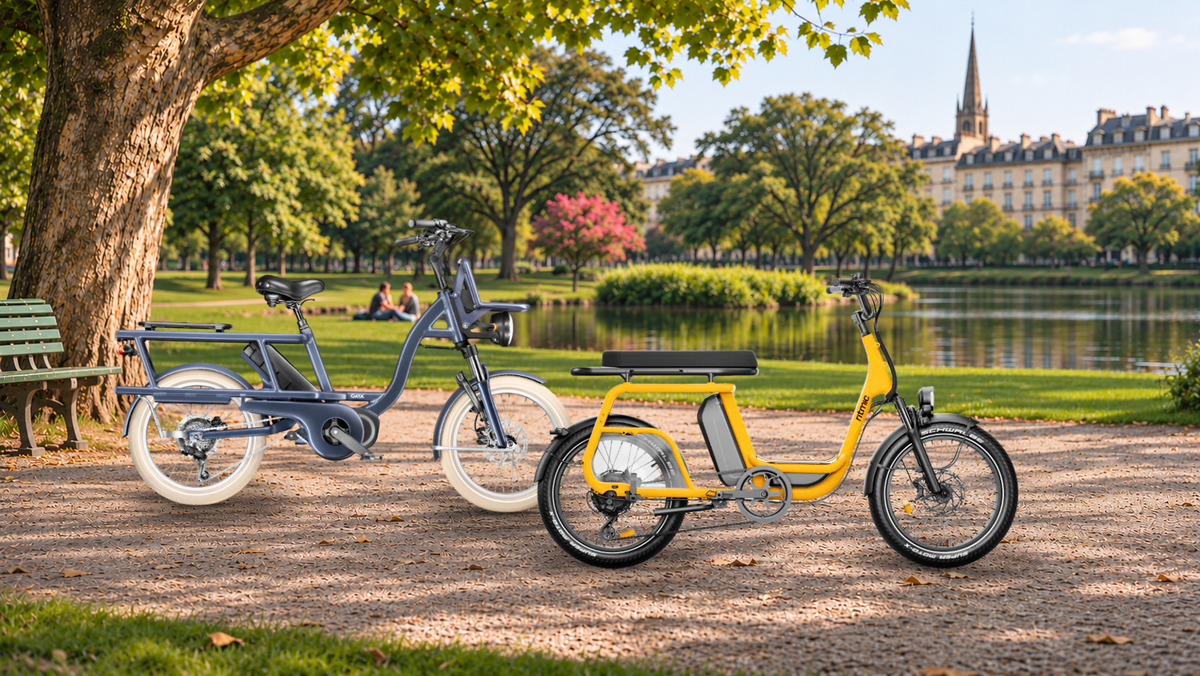
To understand this distinction, let's look at two examples from the Ritmic range: the Ritmic Duo and Solo.
The Duo: a real two-person seat
On the Duo, the seat extends behind the rider to accommodate a passenger. Both people sit on the same elongated seat at a similar height.
This seat is integrated into the bike's design. It doesn't rely on adding a cushion to the rear rack. This gives the passenger a raised position, a clearer view, and a seat designed for an adult.

Duo: an electric bike with a real two-person seat, providing a shared seating area for two people.
The Solo: a cargo bike that can carry two people
The Solo has a different design. The rider has a standard individual saddle. At the rear, the bike has a rear rack that can be fitted with an adult or junior passenger kit. The kit includes a cushion that attaches to the rear rack and footrests.
The Solo can therefore carry two people, but they don't share the same seat. The passenger sits on a separate seat, usually lower than the rider's.

Solo: a cargo bike that can carry two people with a passenger kit, but without an integrated two-person seat.
Comparison: Duo vs Solo
| Criteria | Duo | Solo with passenger kit |
|---|---|---|
| Seat type | Integrated two-person seat | Individual saddle + rear cushion |
| Real two-person seat | Yes | No |
| Rider's seat | Front section of the two-person seat | Standard individual saddle |
| Passenger seat | Extension of the same seat | Cushion added to the rear rack |
| Passenger height | At the rider's height | Lower than the rider |
| Carries two adults | Yes, standard | Yes, with a passenger kit available as an add-on |
| Passenger footrests | Included as standard | Included with the passenger kit |
Both bikes carry two people, but only the Duo comes with an integrated two-person seat as standard.
This distinction doesn't mean the Solo is less appealing. Its rear rack offers versatility to suit different needs: carrying groceries, accessories, or a passenger.
The Duo, on the other hand, prioritizes a two-person riding experience, thanks to its shared seat.
This is precisely the difference that is important to understand when comparing several electric bikes capable of carrying passengers.
For a broader comparison of different cargo bike designs, also check out our article Ritmic or Gaya: compact cargo bike comparison.
What’s the difference between a two-person bike, a longtail, and a tandem?
Several types of bikes can carry two or more people. But they don’t all work the same way.
| Bike type | Configuration | Main use | Examples |
|---|---|---|---|
| Cargo bike with a two-person saddle | An extended saddle shared by two people | Transport an adult or teenager | Yuvy 3, Duo |
| Compact cargo bike with passenger kit | Individual saddle and cushion on the rear rack | Transport a passenger with suitable equipment | Solo |
| Longtail cargo bike | Extended rear rack that can hold cushions or seats | Transport several children or cargo | Jumbo |
| Tandem | Two saddles and two sets of pedals | Ride together | Moustache Samedi 27X2 |
| Bike with child seat | Standard saddle and separate child seat | Transport a young child | Solo with child seat on the platform |
Why choose an electric bike with a two-person saddle?
The extended saddle isn’t just an aesthetic difference. It also changes the passenger’s experience.
1. A more enjoyable position for the ride
On a cargo bike with a rear cushion, the passenger generally sits lower than the rider. This position can limit their view ahead, especially when the two people are about the same height.
On a Yuvy 3 or Duo, the passenger sits on the same saddle as the rider, at a similar height. They can enjoy more of their surroundings and the scenery without having the rider’s back right in front of them. Sitting close together also makes it easier to chat along the way.
So a two-person bike isn’t just for carrying someone: it also lets you share more of the riding experience.
2. A saddle that’s as comfortable for the passenger as it is for the rider
On Ritmic two-person models, the seat is designed for two people. The two-person saddle is reminiscent of a scooter’s: a large padded seat where the rider and passenger enjoy the same level of comfort.
This is an important difference from a cargo bike with a rear rack. On this type of bike, the rider has a standard bicycle saddle, and the passenger sits on a cushion added at the back, which is often thinner and less padded. On a two-person saddle, neither seat is an add-on: the passenger enjoys the same padding as the rider for the entire journey.
The folding, two-height adjustable footrests allow the leg position to be adapted to different body sizes. Skirt guards also help protect clothing and feet from the rear wheel.
3. A second passenger without having to buy additional equipment
On the Yuvy 3 and Duo, the two-person saddle, footrests and skirt guards are included as standard. You can therefore ride solo or carry an adult passenger without buying an additional passenger kit.
Additional accessories can then be added as needed.
4. A compact bike for riding with a passenger
A bike with a two-person saddle doesn't necessarily need to be much longer than a traditional bike. The Yuvy 3 and Duo measure 182 and 185 cm, respectively.
This means they can carry two adults on a compact cargo bike, particularly suited to urban travel: easy to maneuver, park in a bike space or store in a storage room.
When getting around town as a pair, people often think of a scooter. An electric bike with a two-person saddle meets the same need, while being lighter and more maneuverable. It is also more economical and more environmentally friendly.

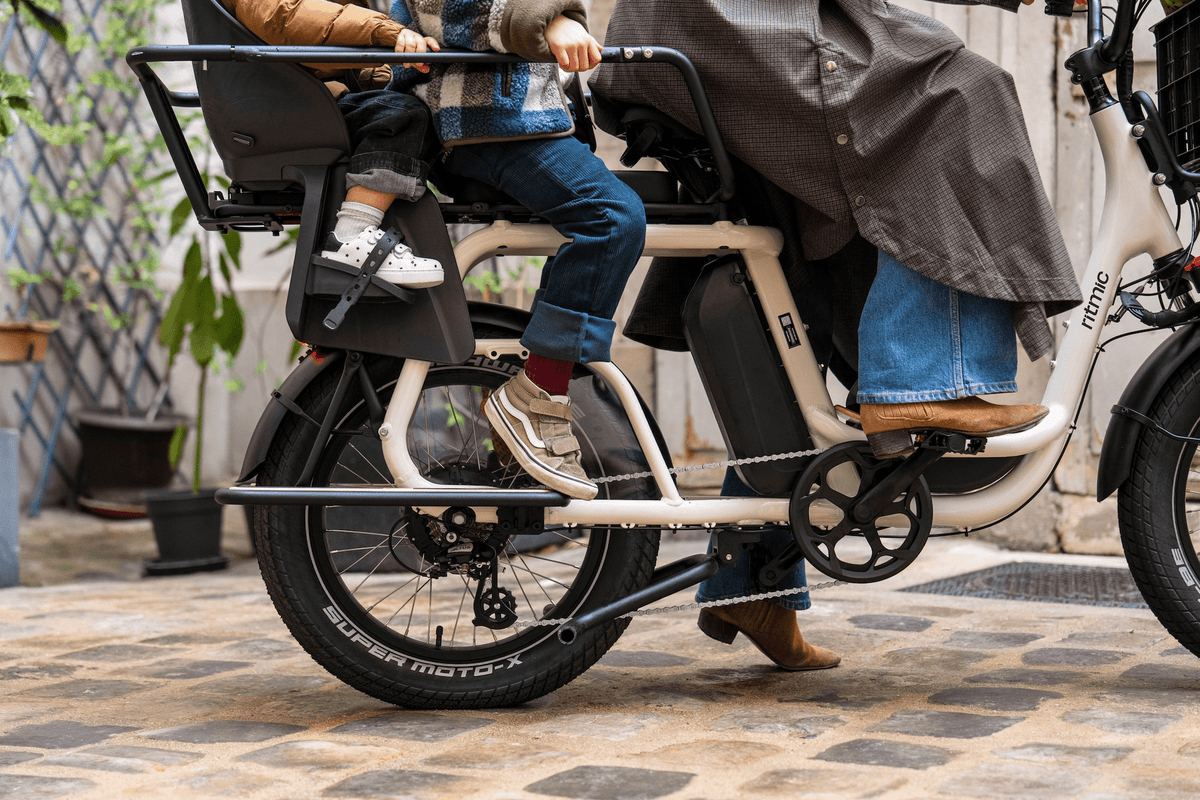
On a Ritmic electric bike with a two-person saddle, the rider and passenger enjoy the ride together, seated at the same height.
Can you carry three people on a two-seat electric bike?
Yes, some electric bikes with a two-person saddle can carry three people. This is the case with the Yuvy 3 and Duo, when fitted with the right equipment.
You need to distinguish between the number of seats on the saddle and the total number of people carried.
On these two models, the two-person saddle accommodates the rider and a first passenger.
You can also install a rear platform behind the saddle to attach a compatible child seat.
The bike can then carry a rider, a passenger on the two-person saddle and a young child in a seat mounted at the rear.
What configurations are possible?
| Configuration | On the two-person saddle | At the rear |
|---|---|---|
| Two adults | Rider + adult passenger | No passenger |
| An adult and a teenager | Rider + teenager | No passenger |
| Two adults and a child | Rider + adult passenger | Child in a suitable seat |
| An adult, a child and a baby | Rider + child who is tall enough | Baby in a suitable seat |
| An adult and a young child | Solo rider | Child in a suitable seat |
On the Yuvy 3 and Duo, the passenger seat on the saddle can accommodate an adult or a junior over 1.10 m tall.
Smaller children must be carried in a seat suited to their size, age and weight.
Which rear platform should you install to carry a child?
To install a child seat behind the two-person saddle, the bike must be fitted with a suitable rear platform.
Ritmic offers two models in particular:
- For the Yuvy 3: the Rear Rack 25, which allows you to install a compatible child seat behind the passenger.
- For the Duo: the MIK 25 Rear Rack, which accommodates compatible accessories, including some child seats.
Both platforms have a maximum load capacity of 25 kg. They are both listed as compatible with the Yuvy 3 and Duo, but differ in their mounting systems and accessory options.
Choose a child seat according to the manufacturer's specifications, particularly regarding the child's age and weight, the mounting system, and compatibility with the platform being used.
The MIK 25 platform, for example, is not compatible with MIK HD mounting systems.

The Yuvy 3 and Duo can carry a third passenger in a compatible child seat installed on a suitable rear platform.
What is the maximum load limit?
The Yuvy 3 and Duo have a maximum payload of 180 kg, excluding the weight of the bike. This limit includes the weight of the cyclist, passengers, luggage, and accessories being carried.
For example, a 75 kg cyclist, a 65 kg passenger, and a 15 kg child add up to 155 kg. This leaves 25 kg of the permitted load capacity for the child seat, accessories, and luggage.
You must also respect the rear platform's 25 kg limit, as well as the maximum capacity specified for the child seat you choose.
Warning: not all bikes with a two-seater saddle can carry three people. This depends on the bike's design and the compatibility of its accessories.
Why is electric assistance especially useful on a two-seater bike?
Carrying an extra adult significantly increases the weight to move. That's why electric assistance plays an essential role on a two-seater bike: it makes starting, climbing hills, and everyday riding easier, even with two people and their belongings on board.
On Ritmic two-seater electric bikes, several features make riding with two people easier:
- A motor suited to carrying passengers: the Yuvy 3 has a motor torque of 65 Nm, compared with 80 Nm for the Duo. The latter is particularly well suited to hilly routes or journeys with a heavy load.
- A start-assist throttle: standard on both models, it lets you get the bike moving up to 6 km/h without pedaling. A real advantage when starting again at a red light or on a hill with a passenger.
- A drivetrain suited to different uses: the Yuvy 3 has a single-speed drivetrain that is easy to use and requires little maintenance. The Duo has 7 speeds, making it easier to adjust your effort to the terrain, especially on hills.
On both models, pedal assistance cuts out at 25 km/h.
Two-seater electric bike: what can you use it for?
An electric bike with a two-person seat is particularly well suited to people who want to share their everyday journeys. Versatile, it meets a range of needs:
- For couples: a two-seater bike lets two adults travel together on a single bike, whether for everyday journeys, shopping or rides. Unlike a tandem, only one person pedals.
- For parents with a teenager: when a child gets too big for a child seat, they can sit directly behind their parent on the two-person seat. On the Yuvy 3 and Duo, this seat is suitable for children over 1.10 m tall.
- For families with two children of different ages: a child who is old enough can sit on the two-person seat, while a younger child rides in a compatible child seat mounted on a rear platform. A practical way to transport two children on a compact cargo bike.
- To reduce car trips: for school runs, shopping, outings or everyday journeys, a two-seater electric bike lets two people make many trips usually taken by car, while enjoying a more affordable and eco-friendly mode of transport.
- For teenagers and young adults: a two-seater electric bike is a more affordable means of transport than a car and offers independence: riding to school or work, or meeting up with friends, alone or with a passenger.
When should you choose a longtail?
A two-seater electric bike is not necessarily the best choice for every family.
If you regularly transport two very young children who each need a specific seat, a longtail is often a better fit. The Jumbo, for example, is designed to accommodate different seat and accessory configurations on its extended rear rack.
The choice therefore depends on the passengers' ages and weights, as well as the types of journeys you make.
To find the format that best suits your everyday needs, also see our guide: Which electric cargo bike should you choose for your needs?.
How to choose a two-seater electric bike
Before buying an electric bike with a two-seater saddle, it's worth checking several criteria.
| Criteria | What to look for |
|---|---|
| Saddle | A continuous saddle that's long enough and designed for two |
| Passenger position | Comfort, seat height, and available space |
| Footrests | Whether they are included and suited to the passenger's size |
| Load capacity | The maximum permitted weight for riders and accessories |
| Motor | Assistance suited to the load and terrain |
| Drivetrain | Single-speed or multiple gears, depending on your routes |
| Braking | Brakes suited to the weight of the loaded bike |
| Carrying a child | The option to add a rear platform and a compatible seat |
| Large size | Length, weight, and ease of parking |
The best two-seater electric bike is, above all, the one that suits how you ride and who you want to carry.
Yuvy 3 or Duo: two electric bikes with a genuine two-seater saddle
At Ritmic, formerly Elwing, the electric bike with a two-seater saddle is central to the range. Launched in 2020, the Yuvy laid the foundations for this design with a long saddle that lets two people ride on a compact bike.
Today, this approach can be found in two models: the Yuvy 3 and the Duo. Both come with a genuine two-seater saddle as standard, with a shared seat for the rider and passenger. Their main differences concern the motor, drivetrain, equipment, and riding comfort.
Yuvy 3 vs. Duo comparison
| Feature | Yuvy 3 | Duo |
|---|---|---|
| Starting price | 2 399 € | 2 799 € |
| Length | 182 cm | 185 cm |
| Weight with standard battery | 34 kg | 36 kg |
| Motor torque | 65 Nm | 80 Nm |
| Drivetrain | Single-speed | 7 speeds |
| Assist levels | 3 | 5 |
| Standard battery | 614 Wh | 691 Wh |
| Long-range battery | 1,008 Wh | 921 Wh |
| Start-assist trigger | Yes, standard | Yes, standard |
| Turn signals | No | Yes |
| Two-seater saddle | Standard | Standard |
| Minimum rider height | 1,66 m | 1.60 m with a low saddle |
| Payload capacity | 180 kg | 180 kg |
| Rear child seat | Yes, with a compatible platform | Yes, with a compatible platform |
Features and indicative starting prices, subject to change.
The Yuvy 3: a simple, accessible two-seater
The Yuvy 3 prioritizes simplicity. With its single-speed drivetrain, 65 Nm motor, and 182 cm length, it's particularly well suited to urban commuting and relatively flat routes.
Its two-person seat lets you carry an adult or a junior without adding a cushion to the rear rack. With its standard seat, it's suitable for riders from 1.66 m tall.
It's an interesting bike for anyone looking for a compact, comfortable two-person bike that's easy to get used to.
The Duo: a more versatile, fully equipped two-person bike
The Duo follows the same two-person seat concept, with additional features. Its motor and 7-speed drivetrain make it easier to handle hilly routes and rides with a heavy load. It also has turn signals, a horn, and a color display.
Its seat comes in two heights. The low version is suitable for riders from 1.60 m tall. The high seat, available as an accessory, raises the seating position by 4 cm: taller riders enjoy greater comfort both when sitting and pedaling, with their legs less bent.
It's a particularly interesting model for people who regularly ride with a passenger, especially on varied routes.
To explore the differences between these two models in more detail, see our full comparison: Yuvy 3 or Duo: which two-person cargo bike should you choose?.
Two-person electric bike: key takeaways
An electric bike with a two-person seat has one key feature: the rider and passenger share a single elongated seat designed for two people.
This design differs from that of a cargo bike fitted with a passenger cushion on its rear rack.
Both types of bikes can carry two people, but their design and the passenger's position are different.
At Ritmic, this distinction is particularly clear:
- The Yuvy 3 and Duo come with a genuine integrated two-person seat as standard.
- The Solo has a single seat and can carry a passenger with a kit installed on its rear rack.
- The Jumbo is a compact longtail designed in particular for carrying children and cargo.
The Yuvy 3 and Duo also go beyond simply carrying two people: they can carry an additional young child in a compatible seat, provided a suitable rear rack is installed.
To discover what difference the two-person saddle really makes to comfort and handling, the easiest option is to take a test ride with your passenger.
Ritmic offers free test rides at more than 150 partner locations in France. Find an appointment near you and book your free test ride.
FAQ: everything you need to know about two-seat electric bikes
What is a two-seat electric bike?
A two-seat electric bike is an electric-assist bike designed to carry two people. In a configuration with an integrated two-person saddle, as on the Yuvy 3 and Duo, the rider and passenger share one long, continuous saddle. The passenger sits behind the rider at the same height, without pedaling.
Is a bike that carries two people necessarily a two-seat bike?
No. A cargo bike can carry two people with a passenger kit installed on its rear rack, without having a two-person saddle.
Can you carry two adults on a two-seat electric bike?
Yes, the bike is designed for this use, within the specified load limits. The Yuvy 3 and Duo can carry two adults on their two-person saddle, up to their maximum payload of 180 kg.
Can you carry three people on a two-seat electric bike?
Yes, on certain models. The Yuvy 3 and Duo can carry the rider, a passenger on the two-person saddle and a young child in a suitable child seat at the rear. LInstallation requires a compatible rear rack and compliance with the load limits and the child seat manufacturer’s instructions.
Do you need to install a rack to add a child seat to a Ritmic two-seat bike?
Yes. To install a child seat behind the two-person saddle, the bike must have a suitable rear rack. Ritmic offers the Rear Rack 25 and Rear Rack MIK 25, which are compatible with the intended configurations. The seat must be compatible with the rack being used and comply with its manufacturer’s requirements.
Can you ride a two-seat electric bike alone?
Yes. A two-seat electric bike can easily be used by one person. The Yuvy 3 and Duo can be ridden solo, with two people or, with a compatible child seat installed at the rear, with three.
Share: