



#1 “It’s really a thing for lazy people”

Contrary to some beliefs, an electric-assist bike (although equipped with a motor) still requires pedaling. The electric assistance can be adjusted according to your fitness level or goals, which will delight those who love effort and sweat.
More than a love of pedaling, one of the most commonly accepted purposes of the electric bike is to replace car use for short and medium trips.
According to a study conducted with our users (2024): electric bike use has replaced car use for 100% of them on daily trips.
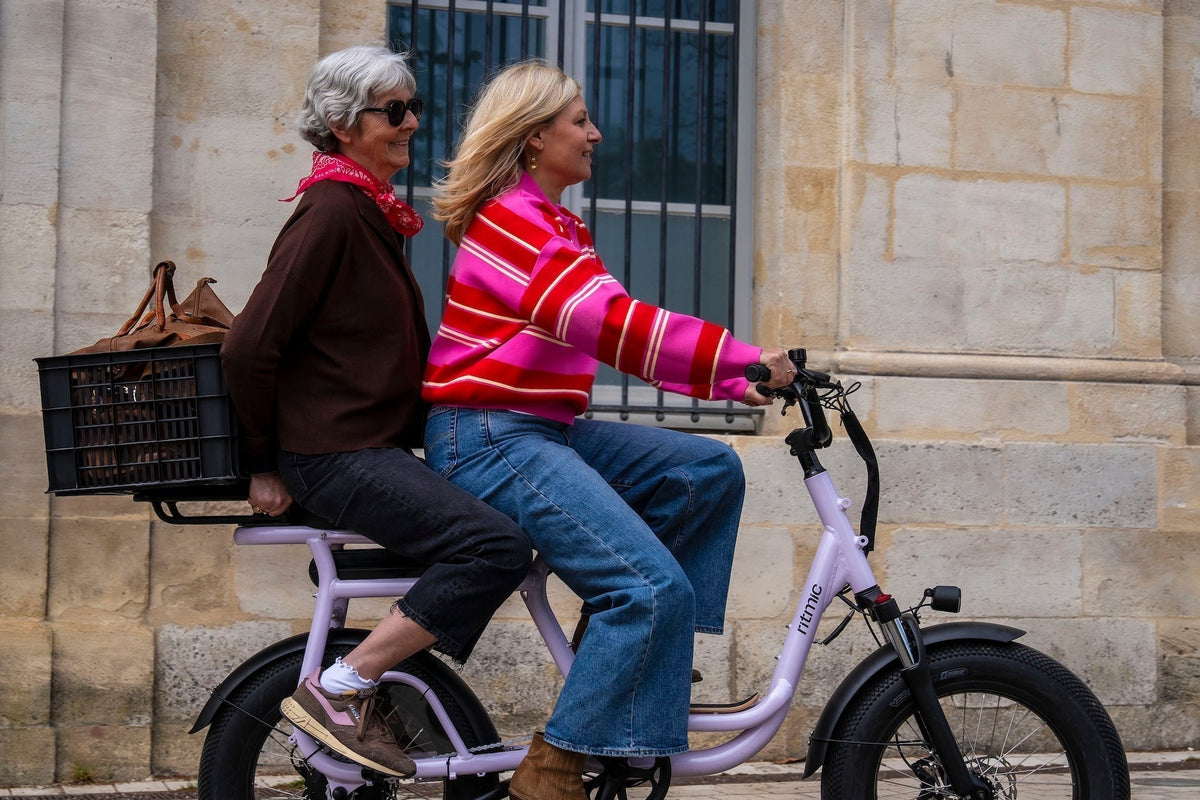
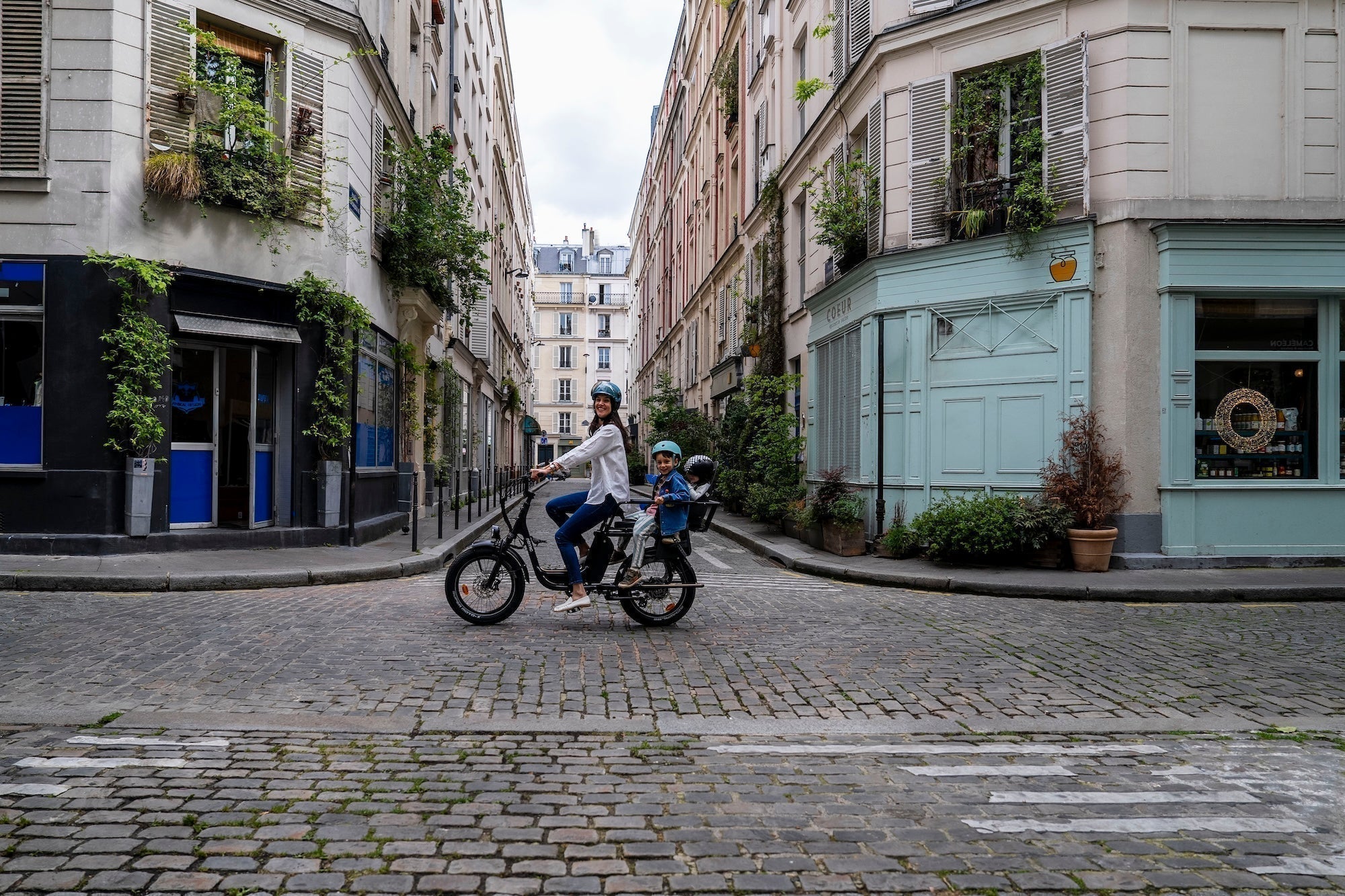
The electric bike has become a full-fledged means of transport: taking children to school, grocery shopping, a city outing… the electric assistance is definitely welcome, especially on hills, when carrying loads, or with two people as with our Yuvy two-seater.
Since it replaces car use, the electric bike is therefore a solution that requires a bit more physical effort than driving a car.
Electric bike use has also reduced public transport use. Taking the subway, tram, or bus still doesn’t require more effort than an electric bike, and the latter can even be seen as the most pleasant and freeing option.
Another advantage is that pedal assistance makes cycling accessible to a wider range of people, including those who might be limited by fitness, age, or health issues.
So next time someone tells us it’s a lazy person’s thing, don’t hesitate to respond:
“No Martine, a dad taking his kids to school on an electric bike is not lazy!”
“Yes Daniel, it’s better to take your electric bike than your car!”
“But Xavier… you don’t put in more effort on the subway!”
And if you want to be lazy, well, that’s your business.
#2 “It goes too fast, it’s dangerous!”

Lack of safety is a common misconception: electric bikes supposedly go very fast and are therefore more dangerous.
However, electric-assist bikes have a speed limit of 25 km/h. In terms of pure speed, they go as fast as a raccoon (whose speed is also limited to 25 km/h) and slower than a mountain bike, scooter, motorcycle, subway, or car.
However, even if they can go slower, it’s proven that on some urban routes, you arrive much faster by bike than by car, public transport, or even on foot.
Traffic jams, parking, traffic rules…: they save a lot of time and ultimately allow you to get around faster, especially in the city. It’s The Tortoise and the Hare reinvented.
Regarding danger, contrary to misconceptions, cyclists are 10 times less likely to be injured than car drivers. The 2023 - 2027 Bike Plan implemented by the government only supports this by developing even more secure and dedicated spaces for cyclists.
#3 “The batteries don’t have enough range”
This argument might have been valid in the 1990s when the first mass-produced electric bikes were launched. Back then, they only had 20 to 40 km maximum range. Today, a standard battery can last up to 60 km (Bordeaux-Arcachon) and a long-range battery up to 110 km (Nantes-Rennes).
By planning your trips and charging regularly, a battery can cover a good distance before running out. With displays showing the remaining battery level, charging can be anticipated just like filling up with gas.
Another advantage is that an electric bike has pedals, which is very practical: a battery failure leaves you less stranded than a car that needs pushing.
#4 “You need insurance, a license, etc. to have an e-bike”

No! No administrative phobia when it comes to electric-assist bikes!
In France, to ride an electric-assist bike (not a speed bike), you don’t need a driver’s license, to register the bike, or to take out specific insurance beyond civil liability.
For an e-bike to be considered as such and not require a license, it must have an electric motor that assists the rider only when pedaling and only up to 25 km/h maximum. Beyond this speed, the assistance must cut off. The motor’s nominal power must not exceed 250 watts. The Elwing Yuvy therefore fits perfectly into the e-bike category.
#5 “It’s a hipster thing”

Electric bikes are not just a "hipster thing" for several important reasons related to urban mobility, the environment, health, and accessibility. They represent much more than a niche trend or a social status symbol. They are a key component of the transition to more sustainable, accessible, and healthy modes of transport, benefiting society as a whole and not just a specific socio-economic group.
In short, far from being a mode of transport for lazy people, eco-hipster types, speed freaks, or simply restrictive, electric bikes offer a multitude of physical, environmental, and social benefits by making cycling more accessible, practical, and enjoyable for everyone.
Let’s ride!

Share: