


When you start looking into electric bikes, you quickly come across some strange words: cargo longtail, speedbike, two-seater, electric hybrid bike... But basically, for many, an electric bike is just a bike that moves when you pedal, right?
And yet, between models, uses, sizes… there are real differences to know. Not always easy to decode if you’re not familiar with the cycling industry. So we decided to keep it simple.
A clear, jargon-free guide to help you in your search and allow you to find the electric bike that really suits you. No overwhelming technical sheets. Just the essentials, model by model, use by use.
Because choosing your bike should be as smooth as riding it.
Table of contents
- The electric city bike
- The compact electric cargo bike
- The two-seat electric cargo bike
- The electric cargo bike, cargo bicycle or cargo tricycle
- The electric longtail cargo bike
- The electric all-terrain bike (VTC)
- The electric mountain bike (eMTB)
- The electric road bike
- The electric gravel bike
- The speedbike (or speed pedelec)
- The electric folding bike
The electric city bike
It’s the most common, the most classic… and often the most intuitive. The electric city bike is designed for daily trips in urban areas: commuting, grocery shopping, dropping kids off at school (with a seat or trailer), or simply riding effortlessly.
It looks like a “normal” bike but with that little extra boost: electric assistance that helps you pedal, especially uphill. The result: you ride faster, farther, without breaking a sweat (even with a shopping bag or headwind).
In terms of comfort, it’s usually flawless: upright position, wide saddle, ergonomic grips. It often comes well equipped from the start: mudguards, rack, integrated lighting, and sometimes even a front basket.
Who is it for?
- For those already used to a classic city bike
- For those looking for a simple, stable bike that’s easy to handle
- For those who leave their bike outside and prefer a discreet model
- For those with a reasonable budget who want good value for money
Examples:
- The Moustache Lundi 27 :

- The Decathlon Elops 900E :

The compact electric cargo bike
An electric cargo bike is a bike designed to carry more than usual: children, groceries, packages… It is reinforced, more robust than a regular bike, and its motor helps you carry without effort.
The compact model is a lighter, shortened version of the cargo bike. It keeps a format close to a city bike but with features designed for transport: an extended or reinforced rear rack, sturdier tires, a double kickstand for more stability, and often a higher load capacity.
It can easily pass for a classic city bike… but the difference lies in what it can really carry. Where a classic bike is designed for one person and a small bag, the compact cargo bike allows carrying a child, a well-filled basket, or delivery panniers.
Another essential difference: comfort designed for passengers. Unlike a city bike (except with a baby seat), the compact cargo bike is designed from the start to carry other people, with more space, better stability, and sometimes even accessories designed for their comfort: footrests, handles, cushions, backrests...
We’ll see a bit later in the article what the word "cargo" really covers, as there are several types with very different sizes and uses.
Who is it for?
- For parents of a child who want to limit car use
- For those who regularly carry groceries, bags, or parcels
- For those who want a sturdy bike but not too bulky
- For those looking for a versatile urban alternative without going for the large size
Example:
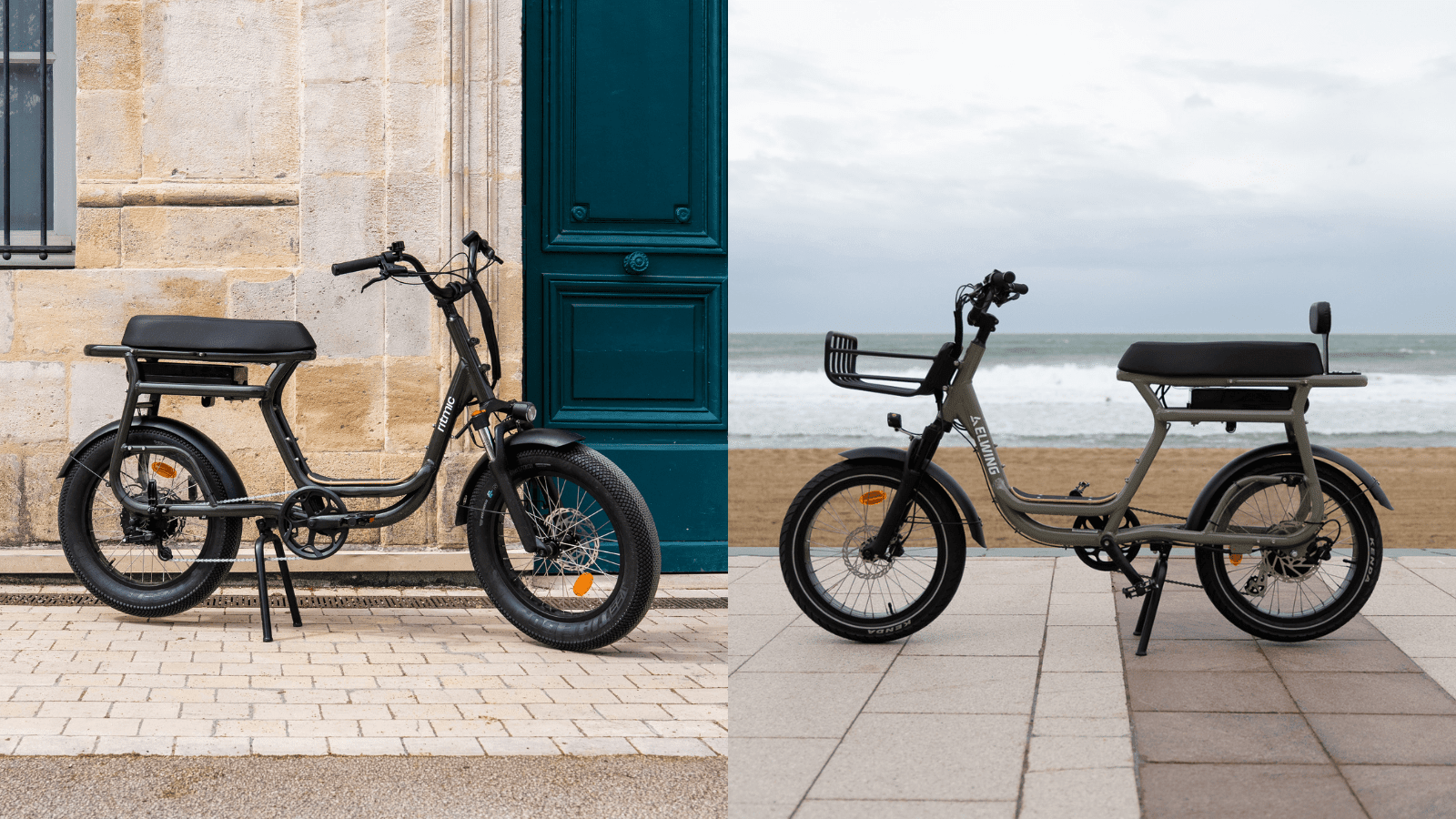
- The Ritmic Solo: a compact, easy-to-handle, and sturdy cargo bike, perfect for everyday urban trips.

The two-seat electric cargo bike
What immediately stands out is its elongated saddle. Like on a scooter.
Except here, you pedal, with the help of an electric motor. Designed to ride with two, this type of cargo bike allows carrying a passenger at the back: child, teenager, or adult, depending on the model. Everything is designed to be comfortable and reassuring: cushion, footrest, handle or bar to hold on to.
The electric assist really makes a difference, even at startup, even when climbing, and ensures riding comfort both on short trips and long rides.
It’s a friendly alternative to the car or scooter, and its compact size also makes it easy to load into the back of a car or caravan, like a classic city bike.
It also has a very sturdy side, designed to support weight without flinching: bags, people, or both.
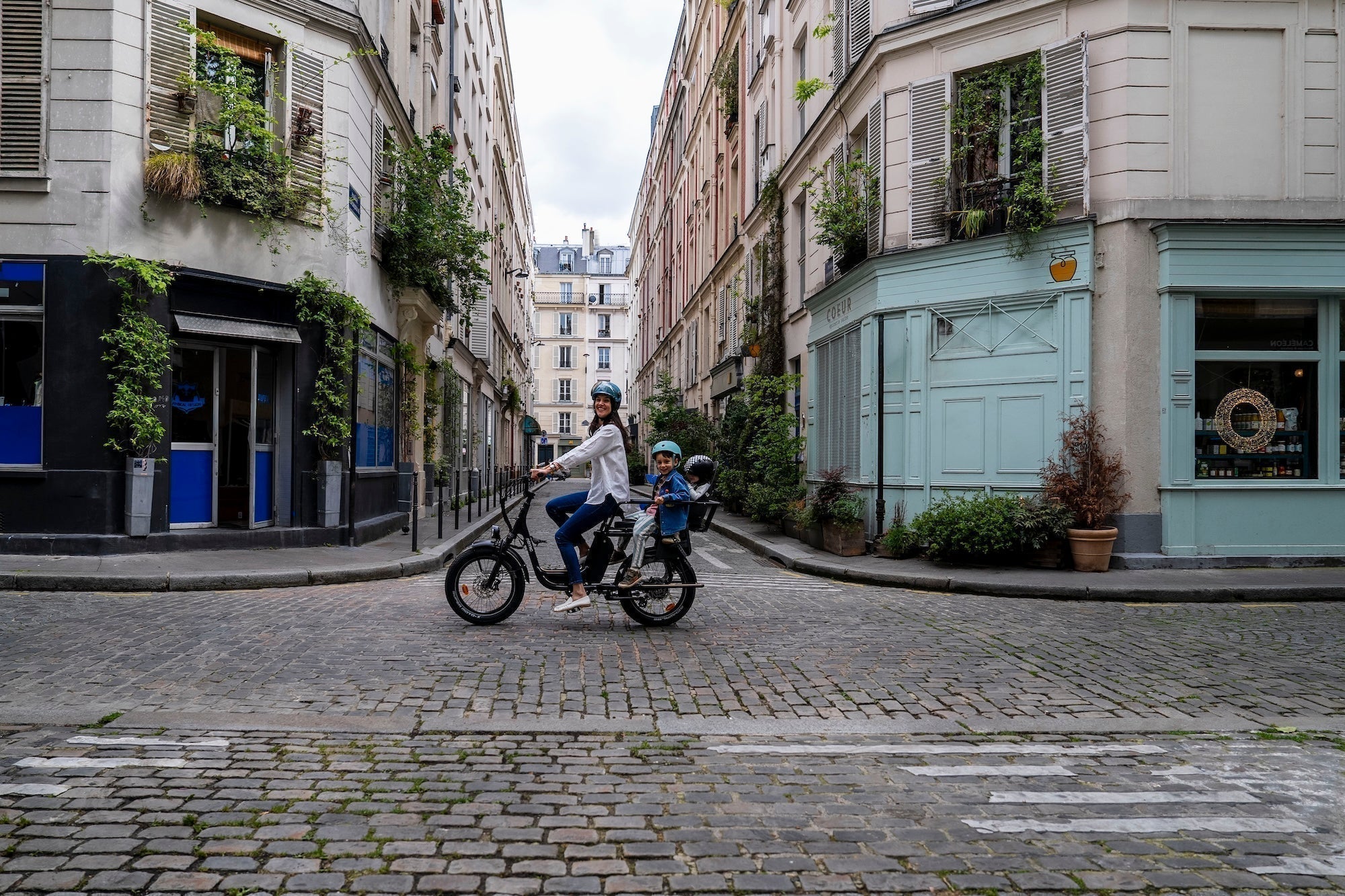
But beware: behind its simplicity, this name is a bit of a false friend (we warned you!). Under its two-seat saddle hides a real cargo bike. It can actually accommodate up to three people in various combinations: a child seat at the front or back, a teenager at the back, two adults and a baby, an adult and a child with a baby… It therefore offers true modularity while remaining super easy to handle.
Who is it for?
- For those who somewhat miss their old two-wheel scooter
- For those looking for a bike for vacations, easy to lock and transport
- For families with one child and a baby, to simplify daily trips
- For teens from 14 years old, to go to school independently
- For everyone who wants a practical and compact bike, easy to park and smoother to ride in the city
Examples:
- The Yuvy 2: compact two-seater electric bike, ideal for trips with two or three people in the city.

- The Ritmic Duo: compact two-seater electric bike, with enhanced performance and comfort.

Moreover, despite its capacity to carry several people, the Ritmic Duo remains surprisingly compact. It easily weaves through the city and stores without hassle.
To give you a clearer idea of its compact dimensions, here is a visual comparison with other types of bikes, including the longtail formats we also discuss later in this article. You’ll see: it carries a lot… without being too imposing.

The electric cargo bike, cargo bicycle or cargo tricycle
Cargo bicycles and cargo tricycles are cargo bikes with a large box at the front. That’s where children are seated, groceries placed, the dog, or even some well-packed parcels.
- The cargo bicycle rides on two wheels: one at the front, one at the back. It is longer than a classic bike, but once you get the hang of it, it remains manageable and pleasant to ride.
- The cargo tricycle rides on three wheels with two at the front. It is more stable when stopped, especially when loading or unloading, but also wider and a bit less agile in turns.
These bikes are often equipped with benches, seat belts, rain covers, and accessories designed to safely carry up to two or three children. Some models also allow you to adjust the space to load packages or equipment.
Electric assistance is essential on this type of bike, because once the box is well loaded, the weight is noticeable. But once moving, pedaling remains smooth, even with a heavy load.
Who is it for?
- For families with two or three young children, to replace the car for daily trips
- For those who want to carry everything by bike, without compromise: children, groceries, boxes, or even the dog
- For professionals doing delivery or local transport looking for a practical and eco-friendly solution
- For those who have a garage, courtyard, or storage space, as this type of bike takes up more room than a classic bike
Examples of brands/models:
- Urban Arrow Family :

- Riese & Müller Load :

The electric longtail cargo bike
The longtail cargo bike stands out with its extended rear frame, integrating a large rack. This extension allows carrying much more than a classic bike: one or two children, bags, groceries, or even an adult depending on the model.
It keeps the look of a traditional bike but with an impressive load capacity. Some models can support up to 200 kg, rider included.
It can be easily equipped: child seats, cushions, footrests, grab bars… It then becomes a real alternative to the car for families or utility trips.
It’s a bit like the limousine of bikes: spacious, comfortable, and elegant, while remaining easy to handle and suited for urban traffic.
Who is it for?
- For parents of two or more children, for all daily trips
- For those who want a family bike that is manageable and pleasant to ride
- For professionals, craftsmen, or couriers who need to transport equipment or regular loads
- For those looking for a robust and versatile bike, but freer in movement than a tricycle
Example:
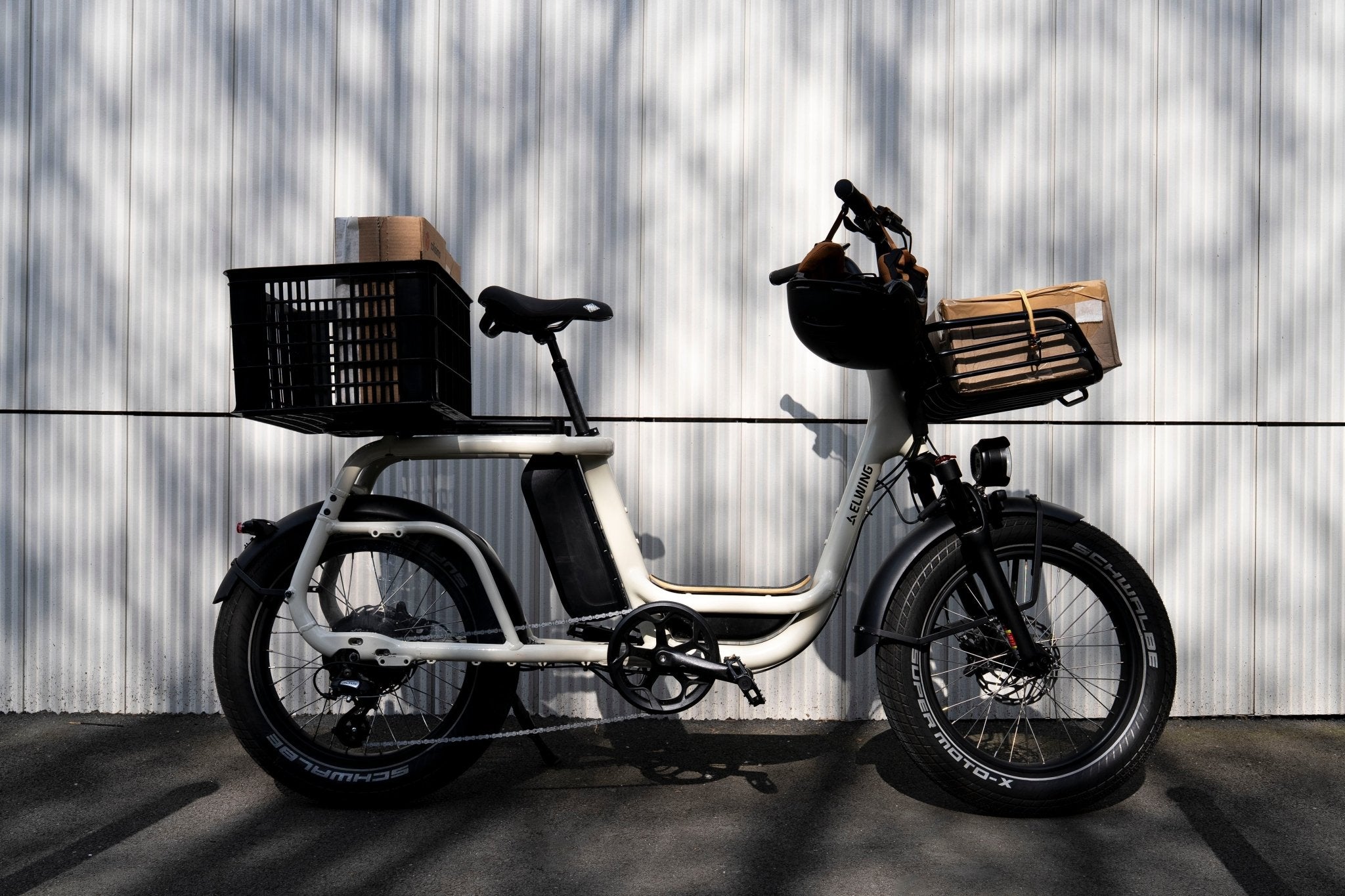
- The Ritmic Jumbo: a sturdy, practical longtail cargo bike designed for families.

This type of bike impresses with its carrying capacity, but it’s not a two-wheeled behemoth. Despite its extended size, it remains surprisingly agile and well-proportioned.
Here is a comparison with other bike models: it carries a lot without taking up all the space.

The electric all-terrain bike (VTC)
The electric all-terrain bike, or VTC, lives up to its name: it’s made to ride anywhere, or almost. It’s the choice for those who want a bike that can adapt to all terrains without having to choose between urban comfort and a desire for adventure.
At first glance, it looks like a city bike. But on closer inspection, it has a few extra advantages:
- wider tires for better grip on trails
- often a front suspension to absorb shocks
- a comfortable position, but a bit sportier than on a purely urban bike
With electric assistance, you can extend distances effortlessly, whether commuting, crossing a forest, or doing a countryside loop on vacation. It won’t replace a true mountain bike in the mountains, but it will take you pretty far already.
Who is it for?
- For those who want one bike to do it all: city, rides, weekends
- For those who ride equally well on road and trails
- For beginners as well as casual cyclists looking for a flexible and adaptable model
- For vacationers who want a bike to explore without hassle
Examples:
- Decathlon Riverside 500E :

- Decathlon Rockrider E-ACTV :

© Decathlon - Rockrider E-ACTV
The electric mountain bike (eMTB)
The electric mountain bike, or eMTB (electric mountain bike), is designed to leave the pavement behind.
It’s the bike for trails, bumpy paths, woods, and terrain that goes up, down, and shakes you a bit.
It carries the DNA of classic mountain biking, with an added motor to help climb, accelerate, and last longer.
What sets it apart:
- wide, knobby tires, to grip even on slippery terrain
- one or two suspensions, to absorb shocks and ride more comfortably
- a sportier position, designed for responsiveness and control
Some models are accessible and made for easy forest rides. Others are designed for more technical adventures, mountains, challenging descents, or intense outings.
Electric assistance is a real asset here: it allows longer rides, climbing without burning out your legs, and opens mountain biking to less trained people.
Who is it for?
- For nature ride enthusiasts who want a sturdier bike.
- For those who want to discover mountain biking without getting tired.
- For athletes who want to ride longer or farther.
Examples:
- Decathlon Stilus E-Bike :

- Specialized Turbo Levo :

© Specialized - Turbo Levo 4 Comp
The electric road bike
The electric road bike is the sporty cousin of the classic racing bike, with a little extra assistance to ease the effort without betraying the spirit.
It’s made to ride fast, far, and especially on asphalt. Lightweight, streamlined, with a sharp frame, a handlebar curved downward (the famous “drop bar”), very thin tires, and a forward-leaning position.
Electric assistance is discreet but very useful. It helps maintain a good pace, climb more easily, or keep up with a group without burning out on the first hill. Here, there’s no question of being carried: it provides just the right support without dulling the sensations.
It’s a bike for those who love speed, consistency, and the joy of sport without pushing themselves to the limit every ride.
Who is it for?
- For those who like to ride fast but want a little help during tough moments
- For former cyclists who want to keep training despite age, injuries, or fatigue
- For those who want to enjoy long road rides without exhausting themselves
Examples:
- BMC Roadmachine AMP :

© BMC - Roadmachine 01 AMP ONE
- Specialized Turbo Creo SL :

© Specialized - Turbo Creo SL Comp E5
The electric gravel bike
The electric gravel bike is a bit like the Swiss Army knife of cycling. Halfway between a road bike and a light mountain bike, it’s designed to ride anywhere — without overthinking it.
With its curved handlebars like a road bike and its wider, knobby tires, it handles just as well on asphalt as on dirt paths, forest trails, or rough roads. It loves mixed terrain, long rides, and a taste for adventure.
The electric assist adds just enough boost to climb, ride farther, or maintain a good pace when the terrain or fatigue start to weigh.
It’s the ideal bike for those who like to vary their pleasures, go on weekend trips or travel with panniers, or just get off the beaten path without going full off-road.
Who is it for?
- For those who alternate between road, gravel, forest, or countryside
- For cycling travel enthusiasts, long rides, or bikepacking
- For those who want a durable, maneuverable, and versatile bike, without having to choose between sport and comfort
Examples:
- Cannondale Topstone Neo :

© Cannondale - Topstone Neo SL 1
- Moma Bikes E-GRAVEL electric bike:

© Moma Bikes - E-GRAVEL 28 PRO electric bike
The speedbike (or speed pedelec)
The speedbike, also called speed pedelec, is an electric bike… that goes faster than the others.
While a classic electric bike assists you up to 25 km/h, the speedbike can help you reach 45 km/h. Result: faster trips, less time lost in traffic or jams.
It looks like a city or road bike, but in a more powerful version. It is designed for long distances, somewhat distant commutes, or routes on major roads where speed is sought.
But this speed comes at a price: in many countries, the speedbike is considered a moped. This means:
- a license plate
- a certified moped helmet, more protective than a classic bike helmet
- sometimes requires specific insurance
It’s a real alternative to scooters or cars for those who want to save time without giving up biking. However, it is forbidden to use bike lanes reserved for bikes with assistance limited to 25 km/h and without assistance.
Who is it for?
- For those who make long regular trips, often outside city centers
- For those who want a bike as fast as their lifestyle
- For active people looking to replace their gas-powered two-wheeler with a smoother and just as efficient version
Examples:
- Stromer ST3 :

- Riese & Müller Supercharger GT rohloff HS :

© Riese & Müller - Supercharger GT rohloff HS
The electric folding bike
The electric folding bike is designed to go everywhere… and especially to fit everywhere! It’s the ideal ally for daily use in multimodal bike commuting. It folds in seconds, is easy to carry, and fits in a trunk, a corner of an apartment, a storage room, or under a desk.
More compact than a traditional bike, it often has small wheels and a shortened frame. But thanks to electric assistance, it compensates for its size: it remains pleasant to use, even if it’s not the fastest or most stable on very long trips.
It’s the bike for “combined” trips: train + bike, car + bike, subway + bike… It keeps up without taking up all the space.
Who is it for?
- For those who lack space to store a traditional bike
- For those who combine several modes of transport during the day
- For those looking for a simple, light, practical bike to take everywhere
Examples:
- Brompton Electric :

© Brompton - Electric G Line with Roller Frame

© Brompton - Electric G Line with Roller Frame
Conclusion
Okay, we admit: that’s quite a bit of vocabulary to digest.
But we promise, once you get the hang of it, it all makes a lot of sense. And above all, it helps you really choose the right travel companion.
There isn’t just one type of electric bike, but a real palette of models designed for very different uses: city, family, sport, getaways, or daily commutes.
The important thing isn’t to choose “the best,” but the one that fits you best — the one that truly simplifies your trips, your daily life, or even your vacations. And if you’re looking for a practical, compact, or family cargo bike, take a look at our range: there might just be a model made for you (and your passengers, your bags, your dog, your needs…).
Share: