


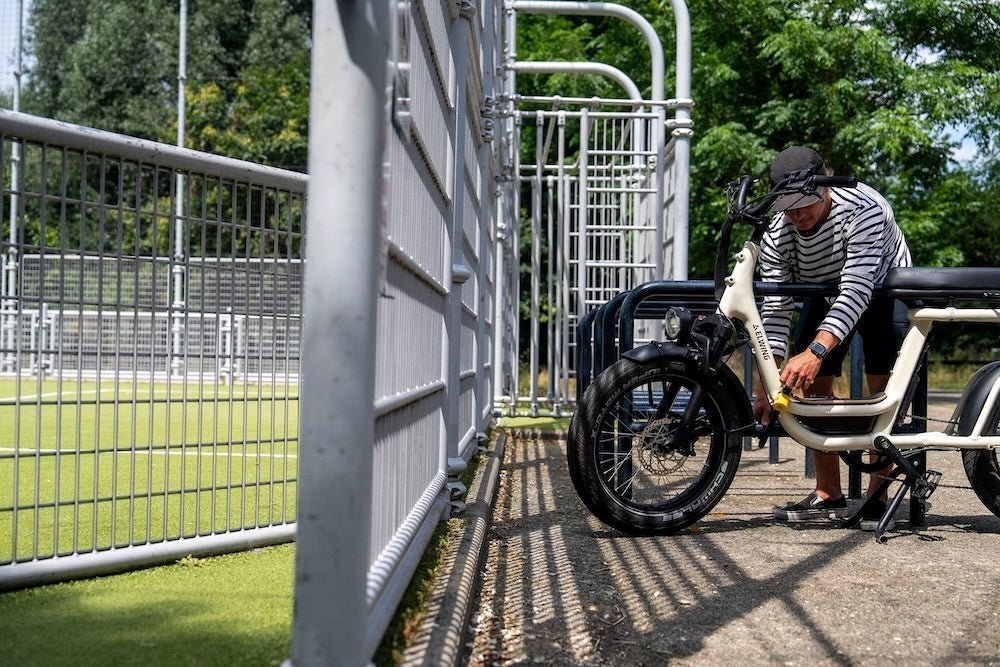
Electric bicycles have become one of the best means of urban transportation: practical, economical, and environmentally friendly, they are transforming our daily lives. But this popularity also attracts unwanted attention. Bicycle theft, particularly in large urban areas, has risen sharply in recent years.
The good news? Simple and effective solutions now exist to let you ride with complete peace of mind.
Certified locks, suitable insurance, good everyday habits, and geolocation tools help secure your bicycle, deter theft attempts… and ensure you are covered in case of the unexpected.
In this article, we guide you step by step through:
- Choosing a reliable lock recognized by insurers
- Understanding the benefits of GPS trackers
- Adopting the right habits for worry-free parking
- Understanding how insurance can protect your investment
Geolocation: useful as a complement
GPS trackers for electric bicycles, such as the Apple AirTag, connected locks, or concealed beacons, allow you to locate a bicycle remotely via a mobile app. They provide some peace of mind, particularly for checking that the bicycle is still where you left it.
How does bicycle geolocation work?
There are two main categories of devices:
-
External trackers, attached to or concealed on the bicycle. They work via:
- Bluetooth (e.g., AirTags), relying on the network of nearby devices.
- GPS paired with a SIM card, providing real-time location tracking via an app. This system generally requires a subscription.
- Connected bicycles, which have a GPS module built directly into their frame or battery. Location tracking is then built in, often more reliable, and invisible to an unwary thief.
However, these devices do not prevent theft: they are intended to help locate the bicycle after it has been stolen. Geolocation is therefore a useful complement, but it must be paired with a good lock.
Choosing the right lock for your electric bicycle
A good lock is the first line of defense against theft, especially in cities. It does not make a bicycle impossible to break into, but it significantly increases the time required for a break-in. The longer a thief takes to act, the more likely they are to be deterred. A properly secured bicycle with a visible, recognized lock is often overlooked in favor of an easier target.
Which lock should you choose to be insured?
Most insurance policies require the use of an SRA-approved or equivalent lock for theft coverage to apply. This is not arbitrary: SRA tests reproduce real-life break-in scenarios, and only truly resistant locks meet the criteria.
Why these requirements?
- Because a non-certified lock can be cut in a few seconds, making theft much easier.
- Because this allows the insurance company to verify that the protection was sufficient at the time of the theft.
- Because thieves also know which locks are the most resistant… and which are purely decorative.
In summary: to be insured, choose a U-lock, a reinforced chain, or an SRA-certified folding lock, or even two locks from this list. Keep your proof of purchase and certification safe (often shown on the packaging or the manufacturer's website), as your insurer may ask for them if you report a theft.
SRA certification: what is it?
The SRA certification (Automotive Safety and Repair) is a French safety standard initially applied to motorcycle locks, but now recognized for electric bicycle locks. An SRA-certified lock has been laboratory-tested against several types of attacks (sawing, drilling, cutting, picking, etc.) and has demonstrated a high level of resistance over a specified period.
Insurers require this certification because it guarantees a minimum level of security: in the event of theft, they can prove that the bike was protected with a serious device. This prevents fraud and reduces the risk of unjustified reimbursement.
It is a guarantee of reliability, recognized by insurers, protecting you not only against theft but also against a claim being denied in the event of a loss.
U-lock
The U-lock (also called a “U-lock”) is considered one of the safest locks on the market. It consists of a highly resistant hardened steel shackle that is difficult to cut, even with powerful tools such as an angle grinder or bolt cutter.
How to use it:
Attach the frame (and, if possible, a wheel) to a fixed, immovable point, such as a bike rack or a sturdy post. Make sure not to leave too much space inside the U, to prevent a tool from being inserted.

Available on our website here - Security rating: 10/10
Thick chain
The thick chain provides a good level of security while being more flexible than a U-lock. It is made of large hardened steel links and must be used with a sturdy padlock.
How to use it:
Wrap it around the frame, a wheel, and a fixed point. It is a good option for places where positioning a U-lock would be difficult.

Available on our website here - Security rating: 10/10
Folding lock
Made of articulated hardened-metal segments, the folding (or articulated) lock offers a good compromise between security, compactness, and ease of transport and storage on the bike. Its locking mechanism is integrated.
How to use it:
Practical for securing a frame to a fixed point, even in tight urban environments. It attaches easily to the frame for transport.

|
 |
Cable locks are very flexible, lightweight, and easy to use… but offer very little security. Even reinforced models can be cut in a few seconds with basic tools.
How to use it:
Only as a supplement to a primary lock, for securing removable components (saddle, front wheel, etc.).
Lock with integrated alarm
Some lock models, particularly U-locks and folding locks, feature an audible alarm system. If an attempt is made to move the bike or suspicious vibrations are detected, a powerful alarm (up to 120 dB) is triggered automatically.
How to use it:
Perfect for parking in urban areas with plenty of foot traffic. The sound creates immediate discomfort for the thief, who may flee to avoid attracting attention. This type of lock combines mechanical protection with an active alarm.

Available on our website here - Security rating 7/10
Best practices for protecting your electric bike
Even with a good lock, everyday habits play a major role in the security of your electric bike. Here are the essential steps to take to drastically reduce the risk of theft.
1. Lock your bike to a fixed, immovable point
Always lock your bike, even when stopping for just a few minutes—it's a basic rule. But pay attention to where and how you lock it:
- Choose bike racks, securely anchored metal barriers, or sturdy posts. Avoid low fences, removable signs, or trees.
- The lock should pass through both the frame and a wheel (ideally the rear wheel, which is more expensive).
- Avoid securing only the front wheel: it comes off easily, and a thief can leave with the frame.
The right approach: tighten your lock as much as possible to limit the space inside the U or chain. This prevents a leverage tool from being inserted.

2. Use two different locks
This is an extremely effective trick. Using two different types of locks (for example, a U-lock and a chain) increases the time required to defeat the security many times over. Thieves act quickly: if it takes them more than 2–3 minutes, they will often give up.
- A fixed frame lock (U-lock) plus a portable lock (chain or folding lock) for the front wheel.
- Ideally, both locks should be SRA-certified to remain covered by insurance.
This also makes breaking in more difficult, since two different tools are required to break them.

3. Remove the battery when parking
The battery is one of the most sought-after components of an electric bike. It is easy to resell, lightweight, and can be worth several hundred euros.
- If you leave your bike parked outside, we encourage you to remove the battery and keep it with you, whether parking for a short or long time.
- This disables the bike, making it less attractive to steal (and harder to test or resell).
- As an added benefit, this prevents it from being exposed to temperature fluctuations or humidity.
If your battery can be locked, check that it is securely locked with the key when you leave it.

4. Choose visible, busy, and well-lit locations
Thieves operate where they feel invisible and undisturbed. To deter them:
- Secure your bike in busy areas: near cafés, in front of shop windows, or along pedestrian routes.
- Avoid dark corners, quiet side streets, or backyards.
- At night, place it under a streetlamp, ideally near a busy area or an open establishment.
Places with plenty of activity and natural surveillance (cameras, pedestrians, shops) are your best allies.
Theft insurance: peace of mind every day
Even when properly secured, an electric bike remains a target. Insurance is your best ally when the unexpected happens.
Why insuring your electric bike is (almost) essential
Even when properly secured with one or two locks, an electric bike remains a highly coveted valuable item. And when it is stolen, the police rarely manage to recover it. Insurance then becomes a true safety net, so you do not lose your entire investment overnight.
What good electric bike insurance covers
Unlike standard home insurance, which is often limited or unsuitable for electric bikes, dedicated bike insurance offers specific coverage designed for everyday use:
- Theft following a break-in or assault: if your bike is stolen while it was properly secured, you are reimbursed, often at its purchase value depending on the bike’s age.
- Accidental damage: a fall, vandalism, or collision can damage your bike. Insurance covers repairs, or replacement if necessary.
- Theft of removable parts: some policies also cover theft of the battery, wheels, or saddle, provided they are firmly attached and locked whenever possible.
These protections are designed to help you avoid everyday unpleasant surprises, without having to buy everything again in the event of a mishap.
What to know before taking out insurance
A few important points to understand how it works:
- Sign-up: usually within 1 to 2 months of purchase.
- Coverage period: it can extend for up to 5 years, with or without a commitment depending on the plan.
- Claim conditions: most insurance policies require the bike to have been secured with an approved anti-theft device (SRA or equivalent). A photo of the anti-theft device or proof of purchase may be requested.
- Simplified claims: in the event of theft or damage, claims can be filed online in just a few clicks. Reimbursement or replacement is generally fast, with no upfront costs.
A simple solution with Ritmic x Estaly

To support its users every day, Ritmic has partnered with Estaly to offer insurance specially designed for electric bikes.
This offer covers theft (following a break-in or assault) and accidental damage. Signing up is simple and entirely online, and claims are handled quickly, with no upfront costs. The insurance can be activated for up to three years, with terms designed for regular urban use.
In summary: how to properly secure your electric bike
Effectively protecting your electric bike relies on a combination of good habits and suitable equipment. Here are the essentials to remember to minimize the risk of your electric bike being stolen:
- Use one or two SRA-certified anti-theft devices, ideally of different types (U-lock + chain).
- Always secure your bike to a fixed, secure point, passing the anti-theft device through the frame and one wheel.
- Remove the battery if you leave your bike parked outdoors, especially at night.
- Add an alarm or GPS tracker to strengthen deterrence or locate the bike in the event of theft.
- Take out suitable insurance to be reimbursed in the event of an unexpected incident and protect your investment.
Ritmic supports you
At Ritmic, every bike is designed for reliable, durable, and safe urban use. To give you even greater peace of mind, we offer:
- Highly secure anti-theft devices, tested and certified, suitable for every need.
- Comprehensive insurance in partnership with Estaly, covering theft, damage, and accessories, with a simple and fast service.
Our mission: to help you ride with peace of mind every day.

Share: